


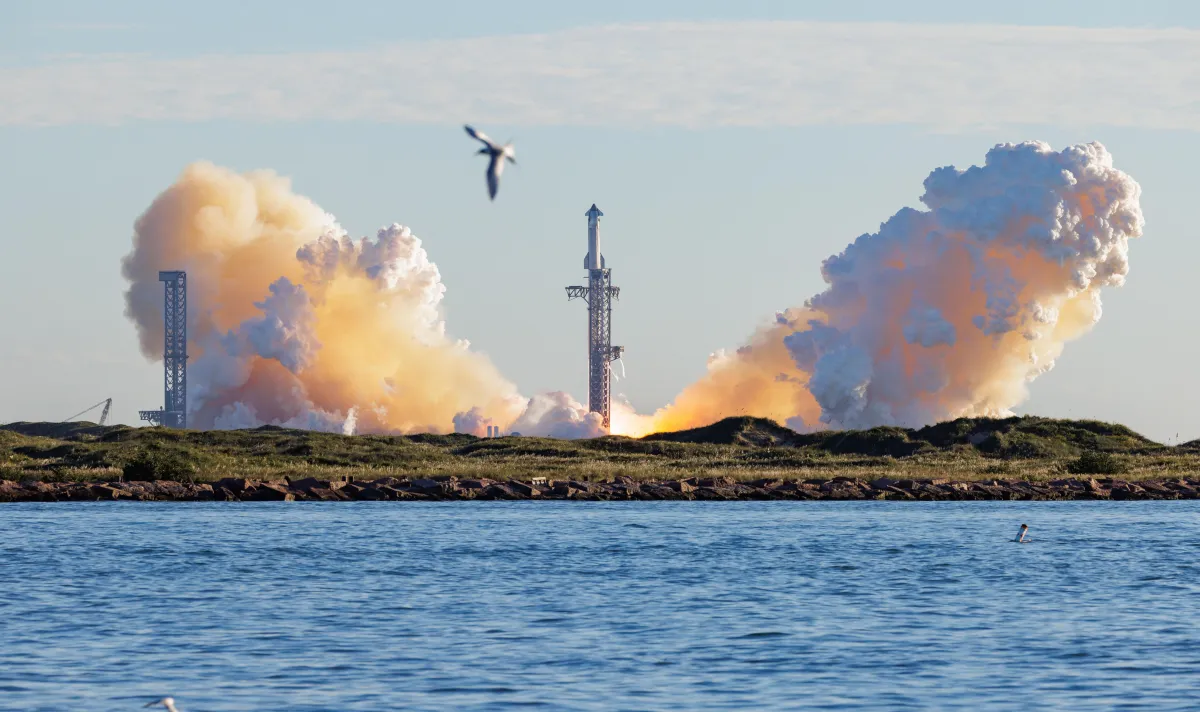

SpaceX’s Starship spacecraft returned to the launch site in South Texas after around 22 hours in orbit and was caught by the tower’s mechanical arms. This was the first successful return and catch of Starship’s upper stage after an orbital flight.
The spacecraft was launched on November 13 from the Starbase facility together with the Super Heavy booster. During the mission, Starship completed 14 orbits around Earth at an altitude of about 265 kilometers and deployed 26 Starlink satellites. According to the Associated Press, this was the 15th flight of a full-sized Starship since 2023 and only its second reaching orbit.
During its return, the spacecraft passed through the atmosphere, performed a flip maneuver and ignited three of its six Raptor engines before being caught by the two large arms of the launch tower. “One of the most incredible and historic engineering achievements happened before our eyes,” said SpaceX commentator Jessie Anderson.
The booster did not reach the tower
The planned simultaneous return of both stages did not take place. The Super Heavy booster was diverted toward the waters of the Gulf of Mexico after the flight control system determined that it was not on the correct trajectory for a catch. After splashing down, the booster exploded.
SpaceX representative Kate Tice said the initial data indicated that the return maneuver had been aborted because of a signal indicating low fuel levels. The company continues to determine the cause of the problem.
Despite the first stage’s failure, SpaceX described Starship’s return as a key demonstration of the concept of a fully reusable spacecraft. Until now, the company had caught three Super Heavy boosters, but not a spacecraft returning from orbit.
Upcoming flights from Texas and Florida
NASA welcomed the result, as it is relying on Starship for future missions under the Artemis program, including transporting astronauts to the Moon. SpaceX expects to begin launching Starship from the Kennedy Space Center in Florida in the coming months.
The successful catch of the spacecraft does not mean that the system is ready for regular flights. The next missions will have to confirm the reliability of the heat shield, engines, navigation and reuse operations.
Sources: apnews.com, cbsnews.com, space.com