


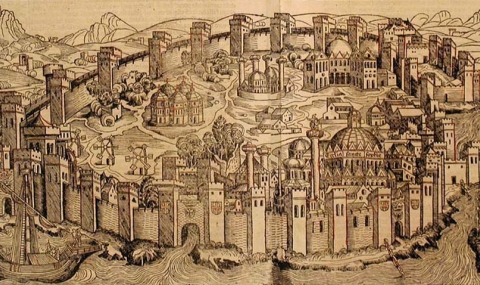

By the end of the 14th century, the emerging Ottoman Empire had established control over significant territories in both Asia Minor and the Balkan Peninsula. Its rise was temporarily halted by their defeat at Ankara and the ensuing infighting, but the empire soon stabilized. By the mid-15th century, Ottoman ascendancy had limited the former Byzantine Empire to the capital Constantinople and a few semi-independent possessions in the Aegean basin, with the emperors relying for their security on diplomatic agreements with the Ottomans and aid from Western Europe.
It seems that as soon as he came to power in early 1451, the young Ottoman sultan Mehmed II set himself the goal of capturing Constantinople, which kept the ties between the European and Asian Ottoman possessions under constant threat. For this reason, he quickly concluded a three-year peace treaty with Hungary and confirmed his sovereignty over the Despotate of Smederevo and the Beylik of Karaman.
The actual siege of Constantinople began on April 5, 1453, when Sultan Mehmed II deployed his troops two and a half miles from the city walls. Against the colossal Ottoman army, consisting of nearly 160,000 men, Emperor Constantine XI Palaiologos managed to gather about 7,500 soldiers, of whom nearly half were foreigners; the Byzantines, hostile to the church union concluded by their emperors, felt no desire to fight.
On April 7, the Ottoman troops approached within a quarter of a mile of the walls and deployed along their entire length, with the Sultan himself with the Janissaries establishing his camp in the center opposite the Roman Gate. On the left flank towards the Golden Horn were the Anatolian troops, and on the right towards the Sea of Marmara - the Rumelian ones, with the Serbian contingent positioned opposite the Adrianople Gate. The Ottoman troops dug in and positioned their artillery, while Serbian sappers began to undermine the city walls. On April 12, the Ottoman fleet reached the city and anchored off Dolmabahçe.
The Ottoman forces began shelling the fortress walls, initially taking no other maneuvers. On the night of April 18, a small Ottoman detachment attacked the walls and was repulsed. On 20 April, three Genoese and one Byzantine ship managed to break through the blockade and enter the port of Constantinople, causing significant damage to the Ottoman fleet, as a result of which its commander Baltaoğlu Süleyman was deprived of his posts and properties.
The sultan's next move was to divert some of the defenders of the city walls to the weakly fortified port of the Golden Horn. Since access to the Golden Horn was blocked by a chain blocking the entrance to the bay, on 22 April he transferred 72 light galleys overland through the hills above Galata.
Internal resistance to the siege and rumors of arriving Venetian reinforcements and a possible Hungarian attack made the sultan hurry and he decided on a last attempt to capture the city, promising the troops permission to plunder it. On 28 May, preparations for the decisive assault began, with two thousand ladders being moved up to the city walls. The attack began three hours before sunrise on 29 May, with several successive waves attacking the city walls.
Sultan Mehmed II himself entered Constantinople on 30 May 1453.