



On June 5, 1967, the Six-Day War began. Israel's victory over the four Arab countries of Egypt, Syria, Jordan and Iraq still causes bewilderment among experts. The phenomenally conducted military operation by Tel Aviv amazes experts because of the uncompromising way in which it deals with the well-armed armies of the Arab countries. Israel no longer manages to repeat the success it achieved in 1967.
The Six-Day War began on June 5, 1967. This is one of the shortest wars in world history. The formal reason for its beginning was the closure of the Straits of Tiran by Egypt. But the reasons for Israel's conflict with its Arab neighbors are much deeper. Syria and Egypt remain dissatisfied with the results of the 1948-49 War of Independence and seek revenge.
By the mid-1960s, Cairo had significantly strengthened its military potential. It had 400 aircraft, 1,200 tanks, and an army of 240,000 soldiers. Damascus was assigned a secondary role in the upcoming military campaign, but Syria's role in the Six-Day War should not be underestimated.
Tensions between Tel Aviv and Damascus increased due to the lack of agreement on the distribution of water resources in the region. As early as 1964, Syria was ready to start a war to stop the construction of the water pipeline that would supply all of Israel with water. Later, the Arab countries began to implement their own project, which was to redistribute the water resources of the Jordan River. Lake Kinneret has always been and remains the main source of drinking water for Israel, and the new canal of the Syrians could lead to a drop in the water level in it, which is categorically not to Israel's liking. Then the IDF aircraft attacked construction sites in Syria. In response, Syrian sabotage groups carried out a number of attacks in Israel.
In the event of a war with Israel, Syria relies on help from Egypt. The country's President Gamal Abdel Nasser can earn good political dividends by siding with Damascus in the event of a possible aggression, which, as everyone believes, is being prepared by Israel. In the interest of truth, it should be noted that the military and diplomats in Tel Aviv are adding fuel to the fire by openly making statements about the possible overthrow of the regime in Damascus.
On May 10, 1967, the Chief of the General Staff of the Israeli Armed Forces (IDF) Yitzhak Rabin stated that it was not excluded that the army would launch an attack on Damascus in the event of a provocation from Syria, the website In Brief recalls.
During these days, the Egyptian, Syrian and Jordanian government media are intensifying their attacks on Israel. Egypt begins the redeployment of troops to the Sinai Peninsula. What's more - Gamal Abdel Nasser manages to get the UN peacekeeping contingent stationed on the border between the two countries to withdraw. The Egyptian army closes the Straits of Tiran. Nasser's actions enjoyed the unconditional support of the Soviet leadership, which consciously maintained the aggravation of the situation in the Middle East. Even the insistence of the United States and Great Britain could not make Egypt retreat. And the massing of Syrian and Jordanian troops on the border with Israel made war inevitable.
„For years, Israel had been warning day and night that closing the straits meant war. Even the great powers had agreed in principle with such a position after our withdrawal from Sharm el-Sheikh in 1957. Nasser, an experienced political player, nevertheless decided to try his luck: he believed that he would be able to tighten the noose around Israel without war, despite the unequivocal statements of the Israeli government, whose population, after mobilization, expected the further development of the situation; the army - with tension, the rear - with great anxiety“, writes Israeli General Haim Herzog in the foreword to William Churchill's book.
The war began on June 5 at 7 a.m. with a massive air strike by the Israeli Air Force on Egyptian military airfields. It was the first day that predetermined the outcome of the entire campaign, which ended with the complete defeat of the forces of Egypt, Syria and Jordan. In order to mislead the enemy, the Israeli media on the eve of the war published photographs of soldiers resting on the beaches, who had supposedly been demobilized en masse.
Egypt's military aviation is the most numerous and numbers about 400-450 aircraft (in Syria - 120, in Iraq - 200, Jordan - 18). The consequences of the crushing blow of the Israelis turned out to be catastrophic for the entire Egyptian army. During the relentless attacks of the Air Force, over 300 enemy aircraft were destroyed. The military leadership of Egypt panicked and ordered the ground forces to quickly withdraw.
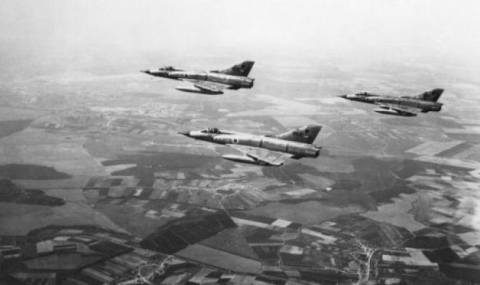
On the same day, Jordan and Syria sided with Egypt, which began shelling the positions of the Israeli army. The Israeli Air Force, consisting mainly of French Mirage aircraft, successfully operated on all fronts. The hostilities continued until June 10 and ultimately brought Israel a victory that entered the military arts textbooks.
“From a military point of view, two episodes of the war were successfully planned and executed: the attack by the Israeli Air Force on the airfields of Egypt, which by the standards of that time was carried out technically perfectly, and the classic battle of the divisions under the command of Ariel Sharon in Sinai with the defending Egyptian divisions. Most of the other battles are rumors. The rapid advance of the Israeli units towards the Suez Canal is largely explained by the fact that after the strikes by the Israeli Air Force on the Egyptian airfields, Amer issued an order for the Egyptian units to retreat. The offensive in Syria began after the Syrian army had left its positions, also after an order from the command. The story is the same with Jordan“, notes the former head of the Israeli intelligence service “Nativ“ Yaakov Kedmi in an interview for "Lehaim" magazine.
In a few days, the Israeli army occupied the entire Sinai Peninsula, the Golan Heights, the Gaza Strip, Judea and Samaria. Only the adopted categorical resolution of the UN Security Council managed to end the war. But the signing of a peace treaty dragged on for years.
The Six-Day War largely determined the modern borders in the Middle East. Syria lost the Golan Heights, Jerusalem was declared the single and indivisible capital of Israel. Until June 1967, the Palestinian territories were under the jurisdiction of Egypt and Jordan. The annexation of these territories to Israel subsequently led to the formation of the Palestinian Authority in its modern form. The question of its status has not been resolved to this day – the world community wants recognition of Palestine, and Israel, in turn, wants to receive guarantees for its security.
Despite the efforts of the entire world community, the Arab-Israeli conflict remains among the main conflicts in the Middle East in the 21st century and continues to be a source of concern for peace and stability in the entire region.