


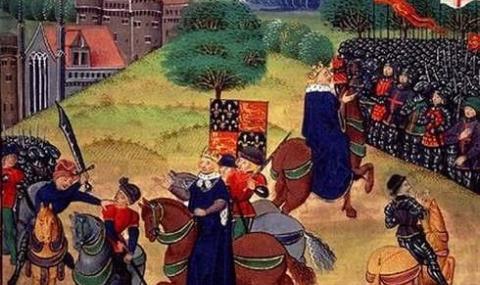

In 1455, the Battle of St. Albans in England marked the beginning of the war for the English throne between the supporters of the Lancasters (with a distinctive red rose) and the ruling dynasty of York (with a distinctive white rose). The conflict lasted 30 years.
In 1399, at the initiative of the barons of the northern counties, Richard II, the last king of the Plantagenet dynasty, was deposed from the throne. The barons placed Henry of Lancaster on the throne under the name Henry IV (1399-1413).
Under the new Lancaster dynasty, the political influence of the reactionary feudal aristocracy significantly increased. Under its pressure, the son of Henry IV — Henry V (1413-1422) resumed the Hundred Years' War with France, which had subsided at the end of the 14th century. After Henry V's death in 1422 in France at the height of his military successes, the crown passed to his son Henry VI, who was not even a year old at the time.
A struggle for the throne began between the largest feudal lords in England for influence and power.
At this time, the successfully resumed war in France took a bad turn for the English. After the end of the Hundred Years' War in 1453, England retained only Calais from all its conquests in France. The defeat of Jack Cade's rebellion (1450) and the class clashes that arose during this uprising forced the wealthy citizens and the "new aristocracy" to abandon the hope of a broad popular movement as a means of combating the domination of the large feudal lords.
Now, placing all their hopes on the change of dynasty, in opposition to the Lancasters began to support the Yorks — relatives of the royal house, also very large landowners in England. Name and symbols. A common statement is that the Red Rose is the coat of arms of the Lancaster family, and the White Rose is the coat of arms of the York family. This is not true - the great-grandchildren of Edward III had similar coats of arms: Henry VI used the coat of arms of the Plantagenets (a combination of the coat of arms of England - three leopards on a scarlet field and the coat of arms of France - three lilies on a light blue background), and the Duke of York had the same coat of arms, but supplemented only with his title. The roses were not coats of arms, but only distinctive emblems of the two warring parties. It is believed that the name "War of the Roses" was not used during the war itself. The term came into use in the 19th century, after the publication of Anne of Geierstein by Sir Walter Scott.
Although roses were sometimes used as symbols during war, in most cases the belligerents wore badges with symbols associated with their feudal lords. For example, Henry's forces at the Battle of Bosworth Field fought under a banner with a red dragon, while the Yorkist army used Richard III's symbol - a white boar. However, evidence of the importance of roses as symbols at the time is the fact that King Henry VII at the end of the war chose as his symbol the combination of red and white roses - the Tudor Rose: a white inner circle from the Yorkist emblem and a red outer ring from the Lancaster sign. Moreover, the names of the warring families have nothing to do with the cities of York and Lancaster, or the counties of Lancashire and Yorkshire. In reality, the lands and castles of the House of Lancaster are mainly in Gloucestershire, North Wales and Cheshire, while the estates and castles of the House of York are scattered throughout England.
Course of the war The rivalry between York and Lancaster escalated into military conflict in 1455, when the Yorkists won the first battle of St. Albans. Soon after, Parliament declared Richard of York as the royal protector and heir to Henry VI. In 1460, however, at the Battle of Wakefield, the Duke of York was killed. The White Rose party was led by his son Edward, who in 1461 was crowned king under the name Edward IV. In these years, the Yorkists won victories at Mortimer's Cross and Towton. In the last battle, the main forces of the Lancastrians were defeated, King Henry VI and Queen Margaret fled the country, but the king was soon captured and imprisoned in the Tower. With some interruptions, the war continued for three decades. The Lancastrians were supported by the largest feudal lords of Northern England, while the Yorkists were supported by feudal lords from the south and east, who had been removed from power by the Lancastrians. The feudal lords of the south-east needed a strong royal authority to help them acquire new wealth, while the others, the aristocrats of the north, wanted to maintain their independence. Active hostilities resumed in 1470, when the Earl of Warwick and the Duke of Clarence (younger brother of Edward IV) sided with Lancaster. They returned the crown to Henry VI. Edward IV, together with his other brother, the Duke of Gloucester, fled to Burgundy, from where he returned in 1471. The Duke of Clarence again sided with his brother, and the Yorkists won at Barnet and Tewkesbury. In the first battle, the Earl of Warwick was killed, and in the second, Prince Edward, the only son of Henry VI, was killed. Soon after, Henry himself died in the Tower.
Thus ended the Lancastrian dynasty.
The struggle between the warring factions was fierce and bloody. Due to the illness of King Henry VI in 1455, the Duke of York, Richard, was declared regent of England, but the Lancastrians removed him and later killed him in one of the battles. A paper crown was placed on his severed head and his head was displayed on one of the fortress walls in the city of York. However, the balance of power changed. In 1461, the son of the fallen Richard, Edward, defeated the Lancastrian army and captured London. King Henry VI was imprisoned in the Tower of London and Edward IV (1461-1483) took the throne. Dissatisfied with the political change that had occurred, in 1470-1471 the Lancastrians organized a coup to restore the imprisoned King Henry VI to the throne, but their attempt was not unsuccessful. Edward managed to defeat the conspirators, capture the prisoner who had escaped from the Tower and kill him. The regime established in England after that was despotic in nature.
The reign of Edward IV did not end the War between the Red and White Roses, which was repeatedly renewed during his reign.
Edward dealt cruelly with the Lancastrian barons. But he did not trust the Yorkist barons either; he brought people from the middle class of chivalry closer to him, giving them titles and lands. Edward also distrusted parliament, whose elections, as before, were influenced by the feudal aristocracy. He forced parliament to vote for him a lifelong right to collect customs duties. All this gave the king considerable funds, made the convening of parliament unnecessary and gave him freedom in matters of government and legislation. Edward IV pursued a policy of encouraging domestic trade and industry. He forbade the export of the most valuable qualities of wool from England, thus stimulating the development of clothmaking; he took measures to ensure the export of English cloth to the Netherlands and Italy without the mediation of the Hanseatic League and Venetian merchants. Edward IV, the first king of the York family, reigned until his death in 1483. He was succeeded by his minor son Edward V.
However, the Privy Council unanimously declared the new king an illegitimate son (the late king was a notorious womanizer and had another secret marriage in addition to his official wife). Thus, Richard, Duke of York (Edward IV's brother) ascended the throne under the name Richard III. He ordered the murder of his brother Edward's minor sons and thus turned the barons of York and the defenders of the Lancaster dynasty against himself. Richard III's short and dramatic reign was filled with a struggle against open and hidden opposition, in which he was initially successful, but the number of his opponents quickly grew. On 22 August 1485, the Lancastrian forces led by Henry Tudor (a great-grandson of John of Gaunt through his maternal line) entered Wales. At the Battle of Bosworth, Richard III was killed and Henry Tudor became king under the name Henry VII, who married Edward IV's daughter Elizabeth of York. In 1487, the Earl of Lincoln (Richard III's nephew) tried to return the crown to York, but was killed at the Battle of Stoke Field.
The bloody Wars of the Roses finally ended. Henry VII (1485-1509) was crowned king,
the founder of the Tudor dynasty. As a result of his marriage to Edward IV's daughter, Elizabeth, he effectively united the Lancaster and Yorkist parties. A single coat of arms was created for both groups. The new ruler strengthened royal power. The centralized English state stabilized. The new aristocracy became the social support of the monarchy. The conditions were created for the consolidation of English absolutism. The Wars of the Roses effectively ended the English Middle Ages. During battles, on the scaffolds, and in prison, not only all the official heirs of the Plantagenets died, but also a significant part of the English knights and lords. The accession of the Tudors is conditionally considered the beginning of the New Age in English history.