


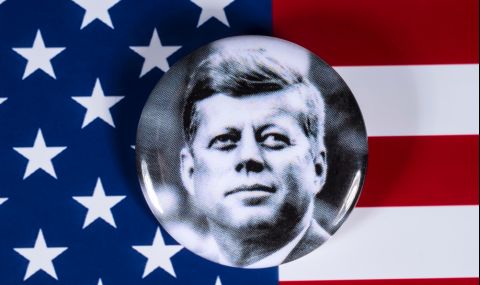

On May 25, 1961, President John F. Kennedy proposed the “Apollo“ program in a special address to the US Congress.
Kennedy said: “I believe that this nation must commit itself to achieving the goal before the end of this decade – landing a man on the moon and returning him safely to Earth.
No space project in this period will be more impressive to mankind or more important to space exploration, and none will be so difficult or expensive to accomplish.“
After receiving the support of Congress and the approval of the Treasury Department, the first space program to send a man to the moon became a fact.
On September 12, 1962, in a speech given at Rice University, President Kennedy stated: “...We choose to go to the moon in this decade and to do other things, not because they are easy, but because they are hard...“.
The "Apollo" program was conceived in the late 1950s and early 1960s during the administration of President Dwight Eisenhower, as a follow-up to the development of the first American space program, the Mercury program.
While the Mercury capsule could only support one astronaut in low Earth orbit, the Apollo spacecraft was designed to carry three astronauts into lunar orbit and land on the Moon. NASA moved forward with planning for the program, although funding was modest due to Eisenhower's inert attitude toward manned spaceflight. In November 1960, John F. Kennedy was elected the 35th President of the United States after a campaign that promised American superiority over the Soviet Union in space exploration and missile defense. Using space exploration as a symbol of national prestige, he warned of a "missile gap" between the two countries and promised to make the United States "the leading power" in this regard. After taking office, Kennedy appointed James E. Webb as NASA director and supported his request for a 30% increase in the agency's budget.
On April 12, 1961, Soviet cosmonaut Yuri Gagarin became the first person to fly in space. This historic flight reinforced American fears of technological backwardness compared to the Soviet Union. The day after Gagarin's flight, at a meeting of the U.S. Committee on Science and Astronautics, many congressmen pledged their support for the lunar program. On April 20, Kennedy sent a memo to Vice President Lyndon Johnson, urging the latter to review the state of the U.S. space program, as well as future programs that would offer NASA an opportunity to catch up with the Soviets.
Johnson responded about a week later. He concluded that "a possible manned landing on the Moon is sufficiently far in the future that it is highly likely that the United States will achieve it before the Soviet Union."