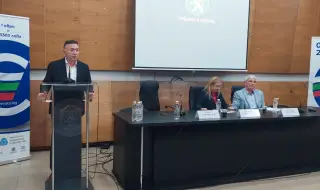
Improvement of the investment environment, increased economic stability, increased income and living standards, equal opportunities for Bulgarian producers when exporting abroad - these are just some of the effects that will follow from Bulgaria's entry into the eurozone. In smaller settlements, medium and small businesses will have better access to investments, which will also create more jobs. The biggest risk in this process is the lack of information.
These conclusions and forecasts were shared by representatives of business, unions, civil society organizations and institutions during a regional discussion on the euro in Karlovo. The event “The Effect of the Eurozone“ was organized by the Economic and Social Council (ESS) as part of the National Information Campaign for the introduction of the euro in Bulgaria.
„In recent years, ESC has been working consistently on the topic of the eurozone and has expressed its support for the state's efforts in its analyses and resolutions. The purpose of the regional discussions we organize is to provide detailed explanations of the upcoming stages and to make it easier for citizens to get informed. It is especially important if people have doubts or questions to ask them to the institutions in order to receive a reliable answer and not become the subject of fraud or disinformation“, said ESC Chair Zornitsa Rusinova during the opening of the event.
„Bulgaria's place is in the eurozone. We are in the final stage of becoming a member of the large European family. This will provide great opportunities for business and I am convinced that by 2026 every Bulgarian citizen will be more European in financial terms. Following the path of other countries, we see that none of them has suffered losses“, said the Mayor of Karlovo Municipality Emil Kabaivanov.
In the three thematic panels of the regional discussion, employers', trade union and civil society organizations, as well as representatives of key state institutions – Ministry of Finance, National Revenue Agency, Consumer Protection Commission, “Bulgarian Posts“ and GDBOP, presented the various aspects of the introduction of the euro.
The eurozone is the best investment that Bulgaria can make for its future. Business is well informed and familiar with the advantages and challenges in the accession process. The experience of the member states shows that the country's entry into the eurozone will have a positive effect on the development of the economy, competitiveness and investments. This opinion was shared by the representatives of the nationally represented employer organizations, members of the ESC - the Bulgarian Chamber of Commerce and Industry (BCCI), the Association of Industrial Capital in Bulgaria (AIKB), the Confederation of Employers and Industrialists in Bulgaria (KRIB), the Bulgarian Industrial Chamber (BIA). Experts from the Ministry of Finance also participated in the business-focused panel.
„Our accession to the eurozone determines how the country will develop in the future. To date, two-thirds of the Bulgarian economy is linked to the European one. The question is how to get the best out of our membership for enterprises and the best for people“, pointed out Ivelin Zhelyazkov, member of the ESC from the employers' organizations and director of “Tripartite Cooperation“ in AIKB.
What will be the effects on income and prices, as well as what will be the control over traders, goods and services, discussed in the thematic panel by the Confederation of Bulgarian Trade Unions, the National Revenue Agency and the Confederation of Bulgarian Workers.
„There are human reasons why we support the eurozone. If we take the experience of the Baltic States and Croatia, we see impressive growth in GDP and people's incomes after their accession“, pointed out the President of the Confederation of Bulgarian Trade Unions and Vice-President of the ESC from the “Trade Unions“ group Plamen Dimitrov.
„In Lithuania, the average salary is already 2233 euros, which is a 3-fold increase from 714 euros upon its entry. In Latvia and Estonia, the growth is 2 times, but this is also a significantly faster pace than in Bulgaria.
If we follow this logic, from the current 1326 euros, the average salary in Bulgaria in 10 years it should double and reach 2700 euros. This is the forecast, if we take the dynamics in the member states so far“, noted Dimitrov.
The third panel – “Useful for citizens“, focuses on practical aspects for people, payment security and fraud prevention. It included representatives of the Directorate General of the Bulgarian Postal Service, “Bulgarian Posts“ and the Karlovo Municipality.
Citizens should be especially vigilant during the dual circulation and when exchanging money.
“It is possible that “well-meaning citizens“ will try to scam you by exchanging your money under the pretext of not waiting in line or that marked banknotes were mistakenly provided. Elderly people should be careful“, warned Inspector Milen Stoyanov from the “Money Laundering“ sector at the Directorate of Anti-Money Laundering. It is safest to keep your money in a bank account, if possible, pay by card to avoid being scammed while getting change back. Merchants should get UV infrared lamps that distinguish real banknotes – this will prevent the entry of counterfeit banknotes, advised Inspector Stoyanov.
The initiative in Karlovo is part of the series of regional events that ESC is holding in the country to provide objective, accessible and reliable information about the process of joining the eurozone and its impact on the economy and society.