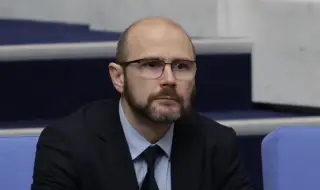
I am convening a plenary session of the Supreme Judicial Council on February 26th with a single item on the agenda: determining a temporary acting Prosecutor General.
In my reasons, I refer to the opinion of the Criminal Chamber of the Supreme Court of Cassation that after July 21, 2025, the Republic of Bulgaria will not have a legitimate acting Prosecutor General. And a situation in which the supreme judges do not recognize the Prosecutor General is intolerable in a state governed by the rule of law.
This is recalled in his position on "Facebook" by the Minister of Justice Andrey Yankulov.
For more than half a year now, the prosecutor's office – one of the most important state bodies with key powers in the judiciary, operates without the necessary guarantees for the accurate and uniform application of the laws by all prosecutors, which guarantees the Constitution personalizes in the figure of the Prosecutor General.
This delegitimizes and deprives of public trust not only this institution, but also the judiciary in Bulgaria.
This is what Andrey Yankulov writes.
In his almost three-year illegitimate “de facto mandate“ Borislav Sarafov has not performed a single action that would build public and professional trust in his managerial qualities. He did not fulfill any of his key requests given when he took office. For example, to clean the prosecution from the network of parallel justice "The Eight Dwarfs", the unraveling of which, according to him, is "a key pledge for the further normal functioning of the entire institution of the prosecution".
Here are the reasons for convening the SJC
REGARDING: Convening a plenary session of the Supreme Judicial Council on 26.02.2026 (Thursday) at 09.30.
DEAR MR. MAGDALINCHEV,
DEAR MEMBERS OF THE SUPREME JUDICIAL COUNCIL,
After 21.07.2025, the Republic of Bulgaria will not have a legitimate Prosecutor General – neither the holder of the position nor the one performing the functions. This is the opinion of the
2
the highest judicial instance in criminal cases, according to which the supreme judges treat the acts of the applicant as “im. Prosecutor General“ Borislav Sarafov as not giving rise to the intended legal consequences for an act of a prosecutor general. The opinion is consistent with the clear will and legitimate goal of the legislator to limit the temporary performance of the functions of the prosecutor general to six months after the entry into force of the amendments to the Judicial System Act - Art. 173, para. 15.
According to a position published more than four months ago, on 02.10.2025, on the website of the Supreme Court of Cassation (SCC)1: “According to the Criminal Chamber of the SCC, the powers of the im. f. Prosecutor General shall be terminated pursuant to Art. 173, Para. 15 of the JSA after the expiration of the six-month period from the entry into force of this provision, therefore a request for the reopening of a criminal case filed by an Acting Prosecutor General after 21.07.2025 does not constitute a valid referral.“
In this sense, there are numerous judicial acts of the Supreme Court of Cassation and the courts of appeal (the vast majority of judicial acts support this thesis, the opposite is advocated in much fewer rulings of the courts of appeal), such as: Decision No. 485 of 12.11.2025 on NDV No. 764/2025, Supreme Court of Cassation, I n.o.; Resolution No. 917 of 6.10.2025 under NDV No. 1162/2025 of the Court of Appeal - Sofia; Resolution No. 325 of 13.10.2025 under NDV No. 999/2025 of the Court of Appeal - Sofia (in the reasoning part); Resolution No. 350 of 31.10.2025 under NDV No. 1025/2025 of the Court of Appeal - Sofia (in the reasoning part); Resolution No. 1085 of 17.11.2025 under NDV No. 1418/2025 of the Court of Appeal - Sofia; Resolution No. 1090 of 18.11.2025 under NDV No. 1401/2025 of the Court of Appeal - Sofia; protocol ruling No. 229 of 18.11.2025 under NDV No. 226/2025 of the Court of Appeal - Burgas; protocol ruling No. 235 of 24.11.2025 under NDV No. 232/2025 of the Court of Appeal - Burgas; ruling No. 1146 of 2.12.2025 under NDV No. 1488/2025 of the Court of Appeal - Sofia; protocol ruling No. 248 of 8.12.2025 under NDV No. 253/2025 of the Court of Appeal - Burgas; protocol ruling No. 249 of 8.12.2025 under NDV No. 256/2025 of the Court of Appeal - Burgas; decision No. 2 of 08.01.2026 under NDV No. 307/2025 of the Court of Appeal – Varna; decision No. 6 of 01.12.2026 under NDV No. 486/2025 of the Court of Appeal –
3
Plovdiv; decision No. 7 of 01.15.2026 under NDV No. 407/2025 of the Court of Appeal – Plovdiv.
The fact that the courts do not accept for consideration legal acts of the applicant as an i.f. Prosecutor General, is a serious legal problem that not only limits Borislav Sarafov's ability to exercise the powers of Prosecutor General in specific criminal cases, but also causes negative consequences for the individuals concerned, the public interest in the field of criminal justice, and legal certainty in general.
However, the dramatic problem that has led to the current unprecedented crisis of the rule of law is that the prosecution as an institution cannot function legally without a chief prosecutor, and this is the opinion of the Constitutional Court (CS), which can be deduced from a number of its decisions over the years.
In 2024, the Constitutional Court, under case number 1/2024, rejected the changes to the Constitution limiting the constitutionally defined powers of the chief prosecutor. The Constitutional Court accepted that: "the undertaking of a significant change in the nature and scope of these powers of the Prosecutor General inevitably reflects on the constitutionally established parameters for ensuring the lawful implementation of the activities of the Prosecutor General"
And more from the same decision: "The practice of the Constitutional Court is permanent and consistent, that through [the constitutional powers of the Prosecutor General] "the constitutional legislator concentrates and personalizes in the person of the Prosecutor General the ultimate responsibility for the lawful exercise by prosecutors of the powers under Art. 127, item 1 – 6 of the Constitution, while also creating an additional guarantee for the accurate and uniform application of the laws (substantive and procedural) within the framework of the Prosecutor General" (Decision No. 2/2017 on case No. 13/2016, Interpretative Decision No. 11/2020 on case No. 15/2019, Decision No. 7/2021 on case No. 4/2021).“
By argument from the stronger ground, since only the change in the nature and scope of the powers of the Prosecutor General under the Constitution limits the guarantees for the lawful implementation of the activities of the
4
the prosecutor's office, then the lack of a prosecutor general undoubtedly leads to even more serious consequences.
The conclusion is correct that the hierarchically structured prosecutor's office could not function lawfully at all in the absence of a supreme leader who would “personalize the ultimate responsibility for the lawful exercise“ of the powers of all prosecutors. For more than half a year now, the Prosecutor's Office has been operating in the Republic of Bulgaria - one of the most important state bodies with key powers in the judiciary - without the necessary guarantees for the accurate and uniform application of laws by prosecutors. This delegitimizes and deprives public trust not only in this institution, but also in the judiciary in Bulgaria.
In a state governed by the rule of law, no one can hold the Prosecutor's Office and the state administration hostage with the de facto performance of the functions of the Prosecutor General practically indefinitely, in violation of Art. 173, para. 15 of the Judicial System Act (JSA), which limits the permissible period for this. Even if the JSA formally allowed the everyday and legal absurdity of a temporary appointment without a term limit, this de facto indefiniteness for the acting Prosecutor General would be in sharp conflict with the Constitution and with the practice of the Constitutional Court regarding the mandate for the titular holding of the position.
It is unconstitutional even legitimate for the elected Prosecutor General to continue to perform the function of such for an indefinite period after the expiration of the mandate, according to Decision No. 4/2005 under Case No. 11/2004 of the Constitutional Court. According to its relevant reasons: “The introduction of this continuity is a matter of legislative discretion. When it is introduced, its legal framework must meet the constitutional requirement under Art. 5, para. 1, which is one of the principles of the rule of law, namely that it must not contradict the Constitution. In this case, there is a contradiction because, when and to the extent that it ensures continuity in the performance of the position, Art. 28, para. 9, clause 2 of the JSA allows, as already pointed out, the extension of the term under art. 129, para. 2 of the Constitution for an indefinite period“.
Even if we ignore the norm of art. 173, para. 15 of the JSA, which was interpreted differently by the two colleges of the SJC, or the legal absurdity of the indefinite temporary holding of a mandated position, of exceptional importance
5
is the managerial question of why exactly Borislav Sarafov must de facto occupy the office of the Prosecutor General, for an unclear period of time and without being able to issue legally valid acts. A state in which the supreme judges do not recognize the Prosecutor General is intolerable by the rule of law. It has no reasonable basis related to the person. There is no argument based on publicly available information about the exceptionality of a specific person, justifying breaking the law specifically because of him. Therefore, we cannot avoid the suspicion that the real reasons for tolerating this absurd situation have nothing to do with the right, the law or the principles of good governance. They clearly lie behind the scenes, where the power of justice is actually exercised.
In his almost three-year illegitimate “de facto mandate” Borislav Sarafov has not taken a single action that would build public and professional trust in his managerial qualities. He has not fulfilled any of his key requests given when he took office. For example, to clean the prosecutor's office from the “Eight Dwarfs” parallel justice network, the unraveling of which, according to him, is “a key pledge for the further normal functioning of the entire prosecutor's office institution“.2 Most recently
6
In the extremely traumatic “Petrohan” case for our entire society, Borislav Sarafov at the very beginning of the investigation made unmeasured statements containing extreme assessments that helped to incite enormous public tension and opposition. It should be recalled here that the last titular Prosecutor General Ivan Geshev was dismissed from his position by the current composition of the SJC precisely because of a public statement.
The described particularly critical state of the rule of law in our country should be put to an end as soon as possible by appointing a temporary acting Prosecutor General.
I am addressing this proposal specifically to the SJC plenum for the following reasons:
Given the existing incompleteness in the JSA, which body is competent to appoint a temporary acting Prosecutor General in the event of early termination or expiration of the mandate of each of the three listed (respectively, the six-month period during which the same person was entitled to temporarily perform the relevant functions), the rule of Art. 46, para. 2 of the Law on Normative Acts (LA), according to which the provisions relating to similar cases shall apply to cases not regulated by law, if this corresponds to the purpose of the act.
In the present case, the “similar case“ is undoubtedly the election of the holder of the relevant position of Prosecutor General or President of a Supreme Court, and not the election of a temporary administrative head in any other body of the judiciary. This interpretation meets the purpose of the law, regulating a different competent body for the election of the three highest heads of judicial bodies, precisely in view of their exclusive powers and their special importance in the judicial system.
7
Therefore, the legal vacuum should be filled by applying a procedure that is closest to the election of the holder of precisely the three highest unique managerial positions, the temporary occupation of which must be regulated by applying the relevant procedure, and not the procedure for any other of the hundreds of managerial positions in the judicial system.
The strongest arguments in support of the cited thesis are precisely when it comes to the position of the Prosecutor General, because, regardless of whether he is a temporary holder of the position or a holder, he primarily exercises constitutionally established powers that far exceed those of any other “ordinary“ administrative head in the prosecutor's office. It is sufficient to point out that the Prosecutor General (temporary or titular), situated at the top of the strictly hierarchical prosecutorial institution, has the exclusive constitutional authority to exercise supervision over the legality of the activities of all prosecutors. According to Art. 139, para. 2 of the JSA, only he may revoke or amend any prosecutorial acts, unless they have been subject to judicial control. No other administrative head in the prosecutor's office or in the court may exercise power that even comes close to that of the Prosecutor General (temporary or titular).
Since the “temporary Prosecutor General“ is actually much closer to the “titular Prosecutor General“ than to any other administrative head in the prosecution service, it cannot be convincingly defended the thesis that the procedure by which he should be appointed should be closer to the procedure for appointing any “ordinary“ administrative head, again, temporary or titular.
It is far from a coincidence that the election of the titular Prosecutor General is carried out by the plenum of the SJC – this achieves much greater representativeness in the election of this most empowered position in the judicial system. That is why this election with a huge legal and moral stake cannot be limited to a body dominated by former and future subordinates of the Prosecutor General and other prosecutors and investigators. An election body in such a configuration, i.e. employees in such former and future hierarchical dependence to internally choose their supreme leader only from among themselves, contradicts European standards for good governance of the prosecution service - regardless of whether as part of the judiciary, from
8
the executive branch or separately from the authorities, and regardless of whether it is managed through a body such as a judicial or prosecutorial council.
The appointment of Borislav Sarafov as acting prosecutor general by the prosecutorial college on 16.06.2023 achieved a result that contradicts any principles of good governance - appointed after an express procedure within less than a day, without any debate on the merits, without a program, without set goals, the implementation of which should be monitored, without the necessary representativeness of the appointing authority, and, it turns out, even without a deadline.
Given all of the above and on the basis of Art. 33, para. 1 in conjunction with Art. 32, para. 1, prov. first of the Judiciary Act, I am convening a plenary session of the Supreme Judicial Council on 26.02.2026 (Thursday) at 09.30 with the following agenda:
1. Appointment of an acting Prosecutor General.
Sincerely,
ANDREY YANKULOV
MINISTER OF JUSTICE
1 https://www.vks.bg/novini/otkaz-za-obrazuvane-i.f.gl.prokuror-02.10.html
2 Borislav Sarafov stated before you from the high rostrum at a public plenary session of the Supreme Judicial Council (SJC) on 06.07.2023, less than a month after his election as acting Prosecutor General. Prosecutor General: “In fact, [the “Eight Dwarfs“ case] deserves to be lost not one day, but perhaps a whole week and even more, because the clarification of this case is a key guarantee for the further normal functioning of the entire institution “Prosecutor's Office“. That is why I will do everything necessary to ensure that all circumstances are presented to the public in an objective and undoubted manner and are ultimately concluded in a lawful, objective manner, in a manner that takes into account all facts, events and incidents as they occurred, including if a decision needs to be made by the relevant colleagues to activate criminal liability in relation to the persons involved.“…. “It is more than clear to everyone that this is, in my personal opinion, an extremely ugly, crude and unpardonable abuse of the institution “Prosecutor's Office“. Fortunately, not with the entire prosecutor's office, but only with the Specialized Prosecutor's Office at that time, which was really used to settle scores and take over businesses.“….. “And indeed, both society and the institution “Prosecutor's Office“ need this case to be investigated and clarified, and cleared up completely in all its aspects, in all its ramifications and metastases““. “It is clear and undeniable to me that the “Eight Dwarfs” case, if not investigated objectively, comprehensively and completely, is an obstacle to the normalization of the prosecutor's office. And the prosecutor's office cannot continue without this case being cleared up in a categorical and objective manner.“ – p. 140 et seq. of the full transcript of the meeting of the SJC plenum on 06.07.2023 - https://vss.justice.bg/root/f/upload/40/pr-20-06-07-2023-Plenum.pdf
This case has not been cleared up at all to date, on the contrary.