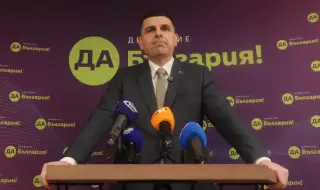
Stopping military aid to Ukraine is not just a foreign policy turn. This is a strategic mistake that directly affects Bulgaria's security. This is stated in a position sent to the media by the co-chair of "Yes, Bulgaria" Ivaylo Mirchev sent a position to the media in connection with the statement of the Minister of Defense Dimitar Stoyanov that Bulgaria is stopping military aid to Ukraine.
Today, Europe is changing. Russia's war against Ukraine has accelerated processes that previously seemed distant - common European defense, common armaments orders, common defense industry, stronger coordination between countries. And at this moment, Bulgaria risks removing itself from the core of European decisions, Mirchev states.
Military aid to Ukraine is not charity. It is an investment in stopping Putin as far away from the EU borders as possible. The weapons we have sent to Ukraine are not a donation. They were paid for by Bulgaria from the European Peace Mechanism, under which we have already received hundreds of millions. Separately, we have sold weapons and ammunition for over €6.5 billion, which have entered the Bulgarian economy, he points out.
When an EU country says: "We will no longer participate", it does not become more peace-loving, but less significant. A division is already taking shape in Europe, not only between rich and poor, not only in Schengen and outside Schengen, not only in the eurozone and outside the eurozone. A new division is taking shape - between the countries that are responsible for the security of the continent, and the countries that are lowering themselves. This is the real "two-speed Europe". At the first speed will be the countries that participate in common defense policies, in new industrial projects, in decisions on armaments, logistics, cybersecurity, border protection and the Black Sea. At the second speed will be all the others, commented the co-chairman of "Yes, Bulgaria".
The danger for Bulgaria is enormous. Not because we will or will not send a few warehouses with old Soviet equipment. But because with such a signal we are telling our partners not to rely on us when it comes to the most important issue - the security of Europe. And when they cannot rely on you, they do not invite you to the table where decisions are made, they do not include you in major projects, they do not give you weight in the allocation of resources, they do not ask you when the future security architecture is being drawn up. This is a huge risk for the country, placing us on the periphery of the unreliable at a time when Europe is reorganizing and taking responsibility for its security, emphasizes Ivaylo Mirchev.