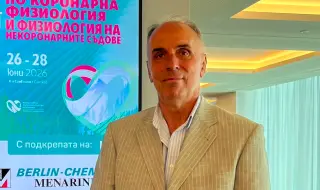
A few days ago, the 14th Bulgarian course in coronary physiology with international participation was held in Borovets, organized by Prof. Plamen Gatsov. Leading cardiologists, cardiac surgeons and specialists from Bulgaria, Serbia, Greece and Italy discussed the latest trends in the treatment of cardiovascular diseases - from modern interventional methods and new possibilities for stents to the revolution in echocardiography and the need for a multidisciplinary approach to patients. What is the level of cardiological care in Bulgaria… Prof. Plamen Gatsov from Pleven Medical University spoke to FACTS.
- Prof. Gatsov, cardiology is one of the fastest developing fields in medicine. What are the most important innovations that were presented at this year's course?
- Cardiology is an extremely dynamically developing field of medicine. More and more new things can be said, especially in the field of cardiac surgery and interventional cardiology. The main goal is to overcome conditions such as acute heart attack, valvular diseases and aortic diseases, which are extremely common. Unfortunately, cardiovascular diseases remain the most common cause of mortality among the Bulgarian population.
- We have been talking about this for years?
- There is a certain effect of the efforts that are being made, but there is still a lot to be done.
- Is that why you invited specialists from other medical fields this year?
- Yes. Cardiovascular diseases are a leading cause of morbidity and mortality. That is why we also invited neurologists, including neurologist Assoc. Prof. Kalpacki from the “St. Anna” hospital, as well as gastroenterologist Dr. Tsonev from the Fifth City Hospital, specialists in nephrology, anesthesiology, radiology, etc. The spectrum of our interests is very wide and the participation of these specialties is of great importance for the proper treatment of patients. This is the complex, multidisciplinary approach.
- Potential participants in the so-called Heart Team, because we are talking about heart problems?
- Yes, there is a lot of talk about the Heart Team, but unfortunately it is not always implemented. And it is not just about the heart team - cardiologists, anesthesiologists and cardiac surgeons. It is about the entire medical team that has a relationship with the patient. Our patients have many concomitant diseases that cannot be considered separately. That is why we need to work together.
- Can we say that there is a trend towards placing fewer stents? We have heard that in some cases balloons and drug treatment are already preferred…
- Yes, I think this is a trend. Stents solve very important problems, for example, in acute blockage or rupture of an artery. But we still leave foreign material in the patient – metal and other components. Of course, we are only talking about cases where this is possible. Where stent placement is necessary, no one questions it. But when there is a different response, it is better not to place a stent.
- Why?
- Because if we place too many stents, we can subsequently make it difficult for surgeons to work if surgery is required in the same area. The balance between excessive activity in placing stents and the correct assessment of when they are needed is extremely important. That is why we organize such scientific forums – to discuss when and what treatment is most appropriate.
- Does this mean that medicine is going backwards – from stents to balloons?
- No. This is not a cycle. This is an upward spiral. In the beginning there was an invasion of balloons, then balloons were replaced by stents, and now stents will probably give way in certain situations. This is the natural development of medicine.
- Thanks to technology?
- Technology is constantly advancing. Each new stage allows us to do something more – either through new medications or new materials. All of this complements the treatment.
- The demonstrations of new ultrasound technologies were also very impressive. The blood vessels are simply visible literally 1:1…
- Yes, this is fantastic. Today we can see the heart almost as if with the naked eye – how it moves, how the valves work, how its walls move.
- How many hospitals in Bulgaria have such equipment?
- There are not a few of them anymore. Maybe about a dozen, even twelve hospitals in Bulgaria have three-dimensional echocardiography. With it, the image is seen practically as if it were real. The heart is before our eyes almost as surgeons see it during an operation. This is extremely valuable.
- What is the level of cardiology in Bulgaria compared to other countries? There were guests from Serbia, Greece, Italy...
- Yes, we had guests from Serbia, lectures from Greece, as well as a Bulgarian colleague who works in Italy. I can safely say that Bulgaria is at a very good level both in Europe and worldwide. Cardiology, interventional cardiology and cardiac surgery in particular are at an extremely high level.
- Where would you place Bulgaria?
- I dare say that we are in the top ten in Europe when it comes to cardiology. In some respects, we are even in first place. Bulgaria is among the leading countries in Europe in terms of the number of catheterization laboratories per capita. We are also among the first in terms of the number of catheterization interventions performed.
- So, Bulgarian patients have quick access to modern treatment?
- Yes. Bulgaria provides very quick and easy access to these modern treatment methods that can really help patients.