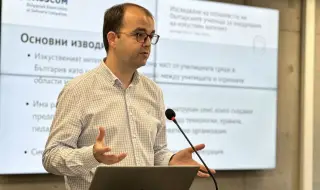
94.7% of Bulgarian students already use artificial intelligence for educational purposes, and nearly half (47.6%) work with it every day or several times a week. The education system is looking for the most appropriate way to integrate artificial intelligence safely, responsibly and effectively. This is shown by the results of the first national study of the organizational, technological and pedagogical readiness for the integration of artificial intelligence in Bulgarian schools, conducted by BASCOM together with the Ministry of Education and Science.
The results of the study were presented by the Minister of Education and Science, Prof. Dr. Georgi Valchev, by Alexander Angelov (BASCOM Board), Dobroslav Dimitrov (BASCOM Advisory Board) and Dr. Lachezar Afrikanov (New Bulgarian University), the project's principal investigator. The discussion was attended by school principals, teachers, university professors, business representatives and experts from the educational and technological ecosystem.
The Minister of Education, Prof. Dr. Georgi Valchev, emphasized that leading nations, which until recently we had as an example where electronic content took over, are beginning to rethink their policies. “But this does not mean that we can get by without technology. Artificial intelligence is indeed developing so rapidly that if we do not find the necessary solutions for its use, we will perhaps cause harm, since it - with or without sanctions - is already being used, so we need to see the possibilities for its implementation in the educational process. I thank BASCOM for this partnership. The study will indeed give us good starting points for finding the right solutions. It is extremely important that this be done with broad public consensus. We cannot postpone good practices for long, which also includes teacher training, because they are the people who must regulate this process”, said Prof. Dr. Georgi Valchev.
The study covers over 10,000 students, 1,767 teachers and 210 school leaders (principals and deputy principals) from 25 administrative districts in the country and provides the most complete picture to date of the introduction of artificial intelligence into Bulgarian school education.
One of the most significant conclusions is that the use of artificial intelligence among students is already widespread and normalized. 56% of respondents said that they learned to use artificial intelligence completely independently, which poses the challenge for the school to set the framework in which students build responsible and sustainable habits for working with new technologies.
Dr. Alexander Angelov from the BASCOM Board outlined three areas in which the state and the Ministry of Education and Science can partner effectively: “There are already several dozen schools that have submitted applications for classes, profiles or other areas related to the development and study of artificial intelligence.
These schools are located in different parts of the country and have different readiness, but if they manage to quickly and without additional resources to implement this, we will have a national network of 20-50 organizations that will become role models and ambassadors of good practices. Our second suggestion is to work on creating curricula that are built from the concept to the tools, because the tools change very quickly and there is neither time nor sense to master them. Our third suggestion is that artificial intelligence should first enter horizontally into administrative processes – with the heads and managers of the education system. When they gain confidence and trust in these technologies, their use will naturally expand to the administrative work of teachers and gradually to the entire educational process”.
According to the study, teachers already have a serious basic literacy in terms of artificial intelligence. Among educators, the highest readiness at the moment is in the use of artificial intelligence in administrative activities, where the benefits are most quickly measurable. The challenge remains for artificial intelligence to be more actively used in the educational process. This outlines the direction for the next big step in practical qualification and methodological support for Bulgarian teachers.
Most often, technology is applied in the preparation of lessons and the creation of teaching materials, while topics such as assessment, task design and tracking of students' personal contributions still require new approaches and methodological support. At the heart of this process is not the technology itself, but the construction of a new type of literacy - skills for critical thinking, responsible use and understanding of artificial intelligence.
The ethical dimensions of AI are already being recognized in the school environment, with the topic going beyond the risk of copying and including disinformation, deepfake content, online bullying, data protection and the impact on student effort.
The data points to clearer written rules, response procedures and understandable communication to students and parents, so that ethical expectations are visible, consistent and enforceable.
According to Dobroslav Dimitrov, only the state can deploy such a comprehensive strategy for the wise use of artificial intelligence at scale. “And only business can provide the most up-to-date information on what is happening in the field of artificial intelligence, as technology changes within months, and sometimes weeks. Even technology people find it difficult to keep up with all the changes, the speed is accelerating and we should not underestimate how big this change is. This will turn every workplace that is not related to physical labor upside down. In the IT industry, this has already happened, the IT industry is literally on its feet right now, and we are the canary in the mine - if this is happening to us now, it will happen in all other sectors very soon. This is no longer about artificial intelligence skills, but about artificial intelligence becoming basic literacy. Without this literacy, a person will have no place in social, economic and professional life”, warned Dobroslav Dimitrov.
The study outlines specific guidelines for systemic support: building a clear national framework for the use of artificial intelligence in education; ensuring safe and manageable access to technologies; introducing school policies and procedures; practical methodological support for teachers and targeted qualification.
“This study does not simply show that artificial intelligence is already present in Bulgarian schools. It shows that the system is entering a new stage, in which spontaneous use must be transformed into conscious pedagogical practice. The big question is no longer whether students and teachers will use artificial intelligence, but how the school will create clear rules, meaningful learning tasks and an environment in which technology supports learning without displacing human connection, critical thinking and responsibility, shared Dr. Lachezar Afrikanov.