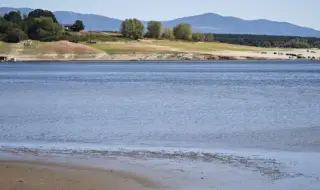
The level is lower than optimal by about a meter, mostly as a result of climate change and direct human intervention. This was stated by the director of the Regional Inspectorate for Environment and Water - Ruse, Daoud Ibryam, on the occasion of the declared partial state of emergency in the municipality of Silistra due to the critical condition of the Srebarna Biosphere Reserve.
The reserve, which is on the List of World Cultural and Natural Heritage, is home to 114 species of birds, of which 22 are rare or endangered. Among them are the nesting Dalmatian pelicans, as well as hundreds of pink pelicans, swans and ducks, writes Nova TV.
The uniqueness of Srebarna is due to the sharp rise in the water level through two channels of the Danube River, which leads to the formation of floating reed islands, inaccessible to terrestrial predators. However, the feeding of the lake is only possible when the river levels are above 12 meters. In recent years, a permanent decrease in the water level of the Danube has been reported, which prevents the natural filling of the reserve.
If adequate measures are not taken, this will have an impact on the entire chain of the lake ecosystem, the director of the environmental inspection warned.
To prevent a catastrophic scenario, the mayor of Silistra, Alexander Sabanov, has formed a crisis headquarters. He pointed out that an order has been issued to declare a state of emergency, and the regional fire safety service will deploy two hydro pumps to transfer water from the Danube to the lake. The operation, which is being carried out for the second year in a row, will also include two pipes donated by the Ruse Water and Sewerage Service. Sabanov recalled that during last year's rescue operation, over 3 million cubic meters of water masses were pumped in over 75 days.
In order not to rely only on crisis measures, the Ruse Regional Inspectorate for Water and Sewerage has a plan to build a stationary pumping station, which will be energy independent through photovoltaics. However, funding for it is still lacking. According to Daoud Ibryam, the institution is also looking for sources outside the national budget, but the processes are happening slowly.
As a force majeure option, the purchase of its own generator and pumps is expected in the coming months, so that the environmental inspection can handle the situation on its own until the final construction of the large facility.