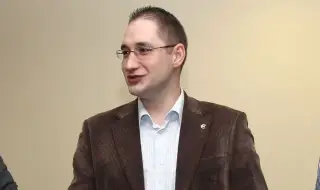
After nearly seven months of work with an extended budget law, the National Assembly is in the final stages of adopting the state budget for 2026. According to the senior economist at the Open Society Institute, Georgi Angelov, this is good news, but it comes with a serious delay, which has cost the country dearly.
„It can also be seen as good news that this agony will finally end - of not having a budget and discussing what is happening in the budget. But, on the other hand, we have lost, perhaps, too much time, in which we could have discussed the budget for 2027 and the reforms that would change this situation“, said Angelov in the program “Intervûto ot dne“
He drew attention to the latest Eurostat data, according to which Bulgaria is in the lead in terms of budget deficit in the European Union.
“Yesterday, Eurostat published statistics on the budget deficit in the European Union and Bulgaria is in first place in terms of the largest budget deficit in Europe since the beginning of the year. Before that, last year we were in first place in terms of the largest increase in government debt. That is, we have serious problems and we must start solving them. Unfortunately, now the debate about the budget is rather political – who is to blame for it being so bad, not how to solve it.“
According to him, a large part of the current spending is inherited and cannot simply be canceled.
„To a large extent, all the spending, all the projects – and the municipalities, etc. – all this was inherited from the previous government. The new government did not even have time to conclude a single contract. So these invoices, these things have to be paid at some point anyway. It is better to clear them up once and for all and for this problem not to arise again.“
According to the economist, however, the most important thing is not just to establish the existence of a deficit, but to begin real reforms.
„The question is not only to establish that there is a problem. We know that there is a problem with the deficit. There have been protests about these budget problems since last year. That's how the government fell. It only admitted that there are problems with the budget. So in that sense, we have no dispute that there are budget problems. The point is to start solving them.“
As an example, Angelov pointed to the reform in the state administration.
„Imagine if 10-20 thousand civil servants had to be fired. It would be better if they were fired this year.“
He argued his thesis as follows: „Because the compensations will be paid, which are an expense and will increase the deficit. But from next year, money will be saved and the deficit will fall. In other words, starting the reforms also costs money. But it's better to do it this year, when the deficit is already large, so that next year we can reap the fruits of these reforms.“
According to Angelov, two different lines of behavior are visible in the ruling majority. “Yes, there is one in this government too. These two wings. One is more reformist, which wants things to happen faster. And the other, which fears that if reforms are made, it will have the opposite effect from the point of view of society.“ According to him, however, public attitudes are already different. “I think that if we see the sociological surveys, people are more likely ready for this change. That's why they voted so en masse for this government - to stop the agony of political instability and deteriorating budgets so far and to make these reforms once and for all. From this point of view, I think that society is ripe for reforms to be made.“
Angelov even gave an example of Germany. “I even think, if you remember, Merkel once made reforms in the summer, during the World Cup, when the focus and attention were on another country. And that was the perfect moment to pass some of the most difficult reforms. The moment has not yet been missed, of course. But by the end of the year, if the reforms begin, next year we may feel the effect. If we wait another half a year, it will be much more difficult for society to accept these changes.“
The maximum social security income will not solve the budget problems Regarding the planned increase in the maximum social security income, the economist stated that the effect on the budget will be limited. “I would say that it does too little for the budget. These are really small things that affect a few thousand people – the maximum insurance threshold, several tens of thousands – the minimum insurance thresholds.“
According to him, the real problem is something else. “In fact, the biggest problem that affects over 6 million people is the invisible inflation tax. The prices of goods, prices in general, are constantly becoming more expensive. This hits the purchasing power of each of us.“
He also explained the reasons for this. “The basis of this inflation is precisely this borrowing from abroad and deficit spending, which pours too much money into the economy, while it produces less. Accordingly, an imbalance occurs that leads to inflation. The sooner this is stopped, the better.“
Georgi Angelov also commented on the warnings of international rating agencies. “It means that they are starting to doubt whether we will cope with this deficit as quickly as promised.“ He gave the example of Romania. “We saw several countries in the region - Romania, Hungary - where these problems also erupted. Last year, remember, Romania was threatened with suspension of EU funds because it was doing nothing about the deficit. The European Commission told them: if you don't do something, we will stop your EU funds for 60 billion euros. And they did something. The point is that what they did was raise taxes, which increased inflation even more. That is, not only must the deficit be reduced, but it must be reduced in a way that does not hit the economy and does not burden people.“
Investments are increasing, but more support is needed
Regarding investments, Angelov noted that the data of the Bulgarian National Bank show a positive trend.
“The interesting thing is that since the beginning of this year we have had a large growth in investments according to the data of the Bulgarian National Bank. That is, we have some movement.“ He specified that there is still no detailed information in which sectors these investments are.
„We do not yet have such detailed data on the specific destinations. But it is positive that there is interest from foreign investors. The question is to channel this interest and help them. This means infrastructure, logistics, industrial parks. That is, there are specific problems that need to be solved in order for an interest to turn into a factory.“
For „Rheinmetall“: Let there be both Bulgarian and foreign investors
At the end of the conversation, Angelov also commented on the changing positions of the government on the project of the German company „Rheinmetall“.
„It is difficult for me to say where it is actually turning, whether it is turning or continuing the same policy. But if you remember, a few years ago there was also a Bulgarian project by a Bulgarian investor - a project for a gunpowder plant, which was stopped.“
When it was clarified that this was Emilian Gebrev's project, he concluded:
“Exactly. That is, the best option is not to prioritize foreign investors or Bulgarian ones. If possible, both projects should happen. Let's have competition first, but also be a bigger producer. And not to say - the foreign one is better or the Bulgarian one is better. Let's both happen.“