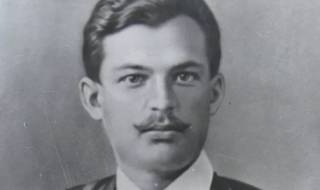
Today, my dear reader of Fakti.bg, we will take you back to the bloody suppression of the April Uprising. Heroism and betrayal mark this great epic. On May 12, 1876, Georgi Benkovski was killed in an ambush in the Teteven Balkan. At least that is how history remembers him, described in Zahari Stoyanov's “Notes on the Bulgarian Uprisings”. If we delve into the annals of history, we will see that he lived both in Istanbul, the heart of the empire, and in its main trading centers. Georgi Benkovski was fluent in seven languages.
Georgi Benkovski was born in Koprivshtitsa on September 21, 1843. In the church register he was recorded as Gavril Gruev Hlatev. He had two sisters - Kuna and Vasilya. He had a difficult childhood, his father Gruyu Hlatev, a small and honest merchant, died in 1848 and this forced Gavril to study only until the 3rd grade at the Koprivshtitsa Primary School, and then his mother sent him to learn a trade - carpentry. Later, dissatisfied with this prospect, he became an apprentice to an abadji, then separated from his master and took up trade on his own.
He toured the large markets in Constantinople and south across Anatolia. He was very successful, earned and spent a lot, but experienced sudden reversals. According to his own words to Zahariy Stoyanov, a person must be able to lie in order to be a successful merchant. For ten years he lived in different places in the Orient - Smyrna, Constantinople, Anatolia, Alexandria, working all sorts of things. For one year he was a sailor to the Persian consul and wore such a nice uniform that people took him for the consul himself. He spoke seven languages - Bulgarian, Turkish, Greek, Italian, Polish, Romanian and Persian. Taking the name Georgi Benkovski, he actively participated in the actions taken by the Bulgarian revolutionary emigration to organize the unsuccessful Stara Zagora Uprising (1875) with the burning of Constantinople and the self-sacrificing April Uprising, which only in the IV Revolutionary District led by him truly broke out, and its cruel suppression led to the declaration of the Russo-Turkish War of Liberation.
During the declaration of the April Uprising, on April 20, 1876 in Koprivshtitsa, Benkovski was in Panagyurishte together with most of the other apostles. When he learned that fighting was already taking place in Koprivshtitsa, he declared the uprising in Panagyurishte as well, after which he quickly formed a detachment and set out to raise the surrounding villages. The Hvarkovat detachment, with which he tirelessly toured the entire region and managed to mobilize and motivate many insurgents, played a central role in the military operations of the uprising. The detachment even included six Croats from Dalmatia and one German who worked at the railway station in Belovo. One of them, Stefan-Dalmatinetsa, was their last bayraktar.
After the brutal suppression of the rebellion in the Panagyurishte region, Benkovski and the detachment headed for the Teteven Balkans, where on May 12, after betrayal by Grandpa Valyo, he fell into the Kostina River, pierced by the bullet of the Bash-poteryadzhia Ryuzgyar Hadji Ahmed Agha. His head was sent to Botevgrad, and then to Sofia. These events were documented by Zahari Stoyanov in “Notes on the Bulgarian Uprisings“. The author himself miraculously survives their organized ambush.