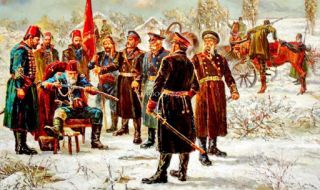
On December 10, 1877, Pleven falls after a five-month siege. Osman Pasha surrenders the city and the garrison. The capture of the city of Pleven is an important moment in the Russo-Turkish War of Liberation, because by freeing significant Russian forces, after the Battle of Sheinovo in early 1878 the road to the Ottoman capital Istanbul was opened.
At the end of June 1877, the Russian army crossed the Danube River near Svishtov. The Russians captured Nikopol, and Osman Pasha led his troops to Pleven. Shortly after, the first Russian military units began to arrive there. The siege and battle for Pleven took place in three assaults, with the first two attacks ending in failure.
After the failure of the two attacks by the Russian troops, Osman Pasha was unable to take advantage of his advantage and repel the besieging troops. On August 31, he nevertheless launched a cavalry attack, which cost the Russians 1,300 casualties, compared to 1,000 for the Ottomans. The Russians continued to send reinforcements to Pleven and their army reached 100,000 people under the personal command of Grand Duke Nikolai Nikolaevich. General Skobelev, recalls Pepa Tabakova in her blog.
On September 3, Skobelev captured Lovech, controlling the supply of the Ottoman forces from the south. The survivors of the Lovech garrison were organized into 3 battalions, which reinforced the defense of Pleven. Osman Pasha also received additional reinforcements from 13 battalions, bringing his army to 30,000 men, the largest number of the entire siege. On September 11, the Russians launched a new large-scale attack on Pleven. Skobelev captured two redoubts on the southern side, and Romanian units captured the important redoubt of Grivitsa from the north. On September 12, the Ottomans regained the southern redoubts, but failed to drive the Romanians from Grivitsa. From the beginning of September to this point, Russian losses amounted to about 20,000 men, while the Ottomans lost about 5,000.
The increasing Russian casualties led to the cessation of direct attacks and a change in command. The Romanian prince Carol I became the official head of the besieging forces, with the Russian general Eduard Totleben, widely known for his defense of Sevastopol during the Crimean War, as his chief of staff. Totleben decided to completely surround and isolate the city, which was achieved after the Battle of Gorni Dubnik on October 24. Osman Pasha requested the command to abandon Pleven and retreat, but was not granted permission to do so. Deprived of supplies, he eventually attempted to break the siege. On December 9, Osman Pasha crossed the Vit River and attacked on a three-kilometer front, passing through the first line of Russian trenches. Outnumbering the Ottomans by almost five times, the Russians pushed them back across the river, with Osman Pasha himself wounded in the battle. After briefly holding their positions, the Ottomans were driven back into the city, losing 5,000 men to the Russians' 2,000. On December 10, Osman Pasha surrendered the city and its garrison to the Russians.