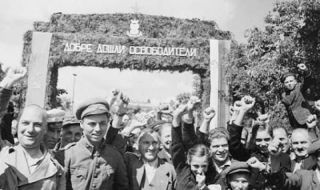
On September 9, 1944, a coup was carried out in Sofia. This was the last coup of Kimon Georgiev. Before that, he participated in the change of power on June 9, 1923 and May 19, 1934.
At 6:25 a.m. on September 9, 1944, the new Prime Minister Kimon Georgiev read a previously prepared Proclamation to the Bulgarian people on the radio and announced the composition of the new cabinet. Shortly afterwards, the regents Kiril and Nikola Mihov were brought to him from Chamkoria, and the third regent Bogdan Filov was in the province. They signed a decree appointing the government, after which they were arrested. Among the first steps of the government was to appoint loyal officers to key positions in the army.
The entire Bulgarian army supported the coup and declared itself in the service of the new government.
Everywhere, military commanders arrested the police and, together with partisan units, repressed the inconvenient.
The army headquarters issued an order to liquidate all enemies of the new government who attempted to resist and refused to surrender voluntarily to the military and militia authorities. The official name of the army was renamed from the Bulgarian Army to the Bulgarian People's Army – abbreviated BNV and in it, among other command posts, the position of assistant - commanders for political affairs of the army was created.
On September 9, by order of Dobri Terpeshev, all partisan formations came down from the mountains and together with the army took power in the villages and cities in Bulgaria and by order of the Minister of War, General Damyan Velchev and already created in General Dobri Terpeshev, the partisan units merged into the Bulgarian Army and military guard units were created called the Bulgarian People's Guard, and an army guard company was created for each military unit, which had both military-political and military police functions.
Everywhere the seizure of power took place without resistance, but in other cases some smaller military and police units exerted such on other larger military units and the forces of the OF, but the resistance was broken.
According to various estimates, the number of people killed during this period is between 20,000 and 40,000 people. Those sentenced to death by the People's Court were 2,730 people - ministers, deputies, journalists, bankers, mayors, priests, landowners, teachers.
The beginning of the coup was set in mid-August 1944. On August 26, under the threat of the advancing Red Army in Romania, the government of Ivan Bagryanov declared Bulgaria's neutrality in the war. It ordered the German troops to leave the country, and those who refused to do so were to be disarmed.
The same day, August 26, the Central Committee of the Bulgarian People's Revolutionary Party issued District No. 4, which set the task of seizing power in Bulgaria through an armed uprising. At the same time, the government began separate peace negotiations with England and the United States in Egypt, hoping to secure the stationing of English and American troops in Bulgaria.
These attempts met with resistance from the Soviet Union, which led to the failure of the negotiations and on September 2, Bagryanov resigned in order to form a new government as a last attempt to prevent the Soviet Union's offensive against Bulgaria.
On September 2, a new government was formed, a coalition of the main opposition and anti-German parties, headed by Konstantin Muraviev.
The Fatherland Front was offered four seats in this cabinet, but it refused to participate, actively preparing for a military coup. The new government continued its attempts at foreign policy reorientation, terminating the alliance with Germany on September 4, beginning the disarmament of German troops on the territory of the country, and releasing political prisoners.
On the same day, German troops captured the headquarters of the Bulgarian corps in Niška Banja and the headquarters of the Bulgarian divisions occupying Serbia.
On September 5, Muraviev's government discussed a decision to declare war on Germany. However, its promulgation was postponed for 72 hours at the request of the Minister of War, General Ivan Marinov, due to tactical problems. In reality, General Marinov had already coordinated his actions with the Fatherland Front, in order to give the USSR the opportunity to declare war on Bulgaria in the meantime. In return for the service, after the coup, Ivan Marinov was appointed Commander-in-Chief of the Bulgarian Army.
Under these circumstances, on September 5, the Soviet Union declared war on the Kingdom of Bulgaria. On September 6-7, unrest began in various parts of Bulgaria in the resulting anarchy. In Varna and Burgas, the Fatherland Front established control over the administration shortly before the arrival of Soviet troops. On September 6, a strike was declared by tram workers in Sofia, the government mobilized them, and the next day their demonstration was dispersed, in which one person was killed.
On September 7, prisons in Silistra and Pleven were attacked and the prisoners were released, and 6 people were killed during the dispersal of a miners' demonstration in Pernik.
Less than 48 hours remained until the coup....