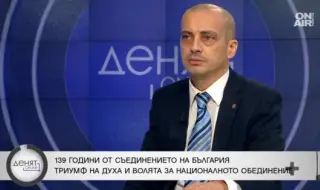
"Indeed, the Unification is very bright date, can only be compared with the Declaration of Independence, which followed the Union, because it was one of the rare occasions when the entire elite and people were united, devoted to a cause that deserved all possible efforts. The union draws its enormous energy as an effort from the centuries of revolutionary struggles, especially from the work of leaders like Levski and many other apostles.
This was stated by the historian Prof. Todor Chobanov in "Day ON AIR".
According to him, revolutionary figures of high caliber participate in the committees.
"The idea immediately arose, a month after the shameful Berlin Congress took place, which split the Bulgarian ethnic land. A month later, the first committees began to be established in Veliko Tarnovo. It is the same in Plovdiv. These were the living legends of the Bulgarian revolutionary struggles. They are very smart and realize that it will not be done just by reading, but also requires serious preparation regarding the public opinion of the people in Europe", added Prof. Chobanov for Bulgaria ON AIR.
According to him, Prince Alexander I of Battenberg is a very bright person.
"Prince Alexander I of Battenberg is a very important figure. It has adventurous elements in it. There were question marks. The prince was a very important element because he was a living bearer of the connections with some of the European great powers. On the other hand from his personal will and position. He is the person who focused the military effort of the Bulgarian people to successfully defend against an unjustified aggression, which, if it had been carried out successfully from the Serbian point of view, would have dealt a terrible blow to the Union", commented the guest.
The political elite was then united for the Union, Prof. Chobanov explained.
"Thracian Bulgarians played the most active role in the process of increasing public energy. These are the people who create the first most active structures. Unfortunately, we are still living in the last stage of the so-called transition. Maybe it will end now. Across Eastern Europe, the parties that made the transition have disappeared. Old parties must be replaced by new ones, and this is a natural process," said the historian.