Comment by Georgi Lozanov:
One of the favorite tricks of Soviet propaganda, continued by that of today's Russia, are false symmetries like "And why do you beat the niggers?". As a rule, its spokespeople do not respond to accusations, but immediately come up with counter-accusations to suggest that the accusers are no better, so it is wisest to remain silent and let the Kremlin achieve its goals.
And now, regarding the war in the Middle East, Putinists are sarcastically asking in the media and podcasts: So what, Putin is an aggressor in Ukraine, but Trump is not in Iran, right? And if the interlocutor is taken aback and backs down with a statement like "When did I say he wasn't an aggressor", he himself falls into the trap and gets bogged down in the inevitable following questions: So Trump can be an aggressor, but Putin isn't, so there are good and bad wars?
Wars - good and bad, liberating and conquering
Asked almost rhetorically, the purpose of these questions is to prevent the interlocutor from realizing that in fact it is exactly like that - wars are good and bad. They are the same only from a bird's eye view. For people, especially in the lands where they are fought, they are either conquering or liberating. Either they impose power on them by force, or they deliver them from the violence of power.
When on March 3 we express gratitude to the Russian troops who helped to liberate Bulgaria, are we celebrating an aggressor? Not even the heirs of the losers of the Russo-Turkish War in today's Turkey accept him as such, who view it as an episode of the natural disintegration of the Sultan's imperial power in the 19th century.
What is Putin doing in Ukraine and what is Trump doing in Iran
In Ukraine in the 21st century, however, Russia is waging a classic war of conquest by occupying territories of an independent state that it wants to be recognized as its own. And at the cost of millions of victims, it is trying to divert Kiev from its chosen path of Western European integration in order to remain subservient to the Kremlin dictatorship. To justify the conquerors, another false asymmetry is being promoted, now on a global scale – Putin was forced to attack to stop NATO's advance. It's as if the pact is not a defensive one, entered into only voluntarily, but has set out to conquer countries by force, as Putin himself does.
Unlike the war in Ukraine, the military actions of the US and Israel in Iran are not aimed at conquering it, but quite the opposite - to free it from the ayatollahs' regime, which is one of the most inhumane on the planet. And this is happening after Tehran had openly declared its intention to destroy Israel, had reached the threshold of creating an atomic bomb, and had fired "at meat" against its own peaceful protesting citizens, killing over 30,000 of them, according to various estimates.
The willingness of Iranians to take to the streets with a clear awareness of what it might cost them showed that not only could they no longer tolerate the oppression of the Islamist dictatorship, but also that there was an alternative in Iranian society. This became an incentive for the United States to once again fulfill its role as a "world policeman", called upon to protect the struggle for democracy where it is most bloody. With the action against Venezuelan President Nicolas Maduro, Donald Trump had already signaled that he was willing to abandon his declared isolationist policy.
The ayatollahs' regime "by the textbook" had all the worst features of a dictatorship based on religious fanaticism: political persecution and arrests, torture and public executions, terror against women and minorities, sanctions against non-observance of Islamic customs, censorship of education, media and the Internet - all of this carried out with edifying cruelty and instillation of fear.
The overthrow of such a regime is a humane gesture. Invoking state sovereignty here is geopolitical hypocrisy, not only because whoever decides to use nuclear weapons is a problem for all of humanity, but also because if it is in your power to stop violence - at home, on the street, in the world, you are obliged to do so, despite possible legal obstacles. The power of law gives way to the right of force when it is exercised over a violent person. Otherwise, democracy will always be a victim of dictatorships that carry violence in their very nature.
If Trump Succeeds in Iran
In other words, the question is not by what right the US got involved in overthrowing the regime in Iran, but whether it will really overthrow it and lead to democratization of the country, regardless of the convenient mantra of the dictatorships that democracy in the region does not thrive. When in a similar situation in the last century the US withdrew from the wars in Korea and Vietnam - albeit in a different way, for decades the boot of Soviet-type dictatorships stepped there. In North Korea it continues to this day and in its sinister absurdity even surpassed the novel "1984" by George Orwell. There they have fallen silent in anticipation of the US failing in Iran.
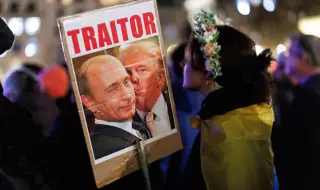
It will not be easy, but if Donald Trump does not leave behind destruction and chaos, but manages to return the human rights of the Iranians, he will achieve the global fame of a savior, which he has so far dreamed of in vain. Secondly, his victory in Iran will be his first victory over Putin and with it he will move from the "new world order", which he is building with dictators like the Kremlin, to the side of democracy, whose geopolitical face for millions of people continues to be the USA. And thirdly, from such a position, and not in deals with a war criminal, he will be able to defend the human rights of Ukrainians much more convincingly. As long as, of course, he wants to.