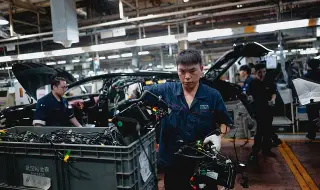
Chinese carmakers are seeking their own "Yaris moment" — the kind of local breakthrough that helped Toyota conquer Europe — as they race to turn booming exports into sustained growth abroad, writes Nick Carey for "Reuters".
After early attempts that largely involved exporting cars designed in China with minor changes, automakers are now redesigning cars from scratch for foreign buyers, driven both by intense pressure on margins at home and opportunities abroad.
China's crowded domestic market has been in a fierce price war for years, leaving many manufacturers struggling to make money. Foreign markets, by contrast, offer room for growth - and higher prices - if Chinese brands can convince consumers they understand local tastes.
Major automakers including BYD, Chery, Changan, SAIC, the MG brand and FAW's premium Hongqi have models in development designed specifically for export markets - from small hatchbacks for Europe to pickup trucks for Australia and Mexico.
For the domestic market, Chinese automakers cram their cars with technology and sell them cheaply to compete. In Western markets such as Europe, they can often sell for double the price and still undercut established brands.
At the Beijing auto show in late April, Hongqi unveiled a small "global SUV" that will be sold in 80 countries. But the car is designed primarily for urban European buyers, he told Reuters. chief designer Giles Taylor.
"This is why this car exists", he said.
BYD's Dolphin G hatchback has been designed specifically for Europe and will be launched in June. Stella Li, the electric vehicle maker's No. 2 executive, said the model was crucial because hatchbacks account for more than 40% of new car sales in parts of southern Europe - a segment that is almost non-existent in China.
"If we don't have the right car in this sector, we lose out," Li said.
A survival strategy
For many Chinese automakers, exports are a matter of survival as analysts predict consolidation will shrink an industry crowded with more than 100 manufacturers. Car sales in China are expected to remain flat or decline.
It has already emerged that other airlines have spoken of requesting a $2.5 billion bailout.
This excess capacity has already helped China become the world's largest car exporter, overtaking Japan in 2024.
Gartner analyst Pedro Pacheco described the drive to design cars for export as a "Yaris moment" of Chinese automakers, referring to Toyota's Yaris hatchback, designed in Europe for European buyers and credited with helping the Japanese automaker establish itself on the continent after its launch in 1999.
Dan Hirsch, global co-head of automotive at consultancy AlixPartners, said globally relevant models were the "Holy Grail for automakers" because scale boosts margins.
In the UK, Chinese brands doubled their market share in the first quarter of 2026 to 14.2%. Across Europe, they almost doubled their share last year to 6% from 3.5% in 2024, according to consultancy Inovev.
Design for Europeans
The rapid export growth of Chinese automakers risks slowing if they remain heavily reliant on vehicles designed for Chinese tastes.
"In China, they are quite experimental with the expression of colors and materials," said Alfonso Albaisa, Nissan's senior vice president of global design. The Nissan N7 EV in China offers options - including "pink-purple" interiors - which are unlikely to resonate elsewhere.
The average Chinese car buyer is also much younger than consumers in Europe or the United States, which shapes design choices and optional features, explained Francois Roudier, secretary-general of the International Organization of Motor Vehicle Manufacturers.
For younger Chinese consumers, "karaoke in the car is certainly important. But for my father - he is 95 - it is not," he stressed.
According to analysts, the coincidence of regional preferences will increasingly determine success as European rivals react to Chinese competition.
"Only competing on price works the first time," said Phil Dunn, managing director of consultancy Grant Thornton Stax. "But the Europeans are struggling with the price," he said, adding that "the Chinese need to take it to the next level" by designing cars in Europe for Europeans.
For Europe, that also means smaller sizes.
Chery, China's largest car exporter, is heavily focused on SUVs, which will account for 2.3 million of the 2.8 million vehicles sold globally in 2025. But Ivan Dulanovic, head of design at Lepas - Chery's new international brand - said a European-focused hatchback, the Lepas 2, was in development.
"We recognized a need in the market and are addressing it," he said.
SAIC's MG is also planning the MG2 hatchback for Europe, where consumers "don't like big cars," said chief designer Josef Caban.
BYD aims to launch more models specifically for Europe and has told investors it wants half of its sales to come from overseas by 2030.
Launch plans
The push to boost overseas sales is also changing launch strategies.
Jetour, an SUV brand owned by Chery, is designing its first all-electric vehicle — the compact TX — with European buyers in mind, said Jetour International President Ke Chuandeng. The upcoming F700 pickup truck will target markets such as Australia and Brazil and will be launched in Mexico before China, he said.
Chery will also introduce a plug-in hybrid pickup truck in Australia this year, said local managing director Lucas Harris.
"We are not gentle with our cars. So if it can survive here, it can probably survive anywhere,” Harris said.
State-owned Changan is developing a range of hatchbacks, compact SUVs and pickup trucks for Europe and other markets, with a launch expected from the end of 2027, said chief designer Klaus Ziciora.
"The competition is so fierce and the investment is very high. So you have to make sure you get enough scale," Ziciora explained.