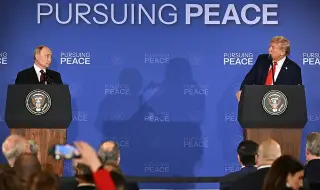
US President Donald Trump said yesterday that Russian leader Vladimir Putin's proposal to voluntarily maintain limits on deployed strategic nuclear weapons for one year "sounds like a good idea", Reuters reported.
What would this mean for nuclear arms control and what are the main problems ahead?
What is Putin saying?
After long refusing to tackle arms control on his own, Putin in September proposed voluntarily maintaining for one year the limits on deployed strategic nuclear weapons set out in the New START treaty, which expires on February 5, 2026
This is the last remaining arms control treaty between Russia and the United States. It was signed by then-Presidents Barack Obama and Dmitry Medvedev in 2010 and entered into force in 2011, having been extended for five years in 2021 by Putin and then-US President Joe Biden.
What is a "strategic" weapon?
Strategic weapons are typically long-range and designed to influence the outcome of a war, not just a battle, by destroying centers of power, command and control facilities, or nationally critical infrastructure.
Why does it matter?
Russia and the United States together possess about 87% of the world's nuclear weapons - enough to destroy the planet many times over. According to the Federation of American Scientists, Russia has 5,459 nuclear warheads, while the United States has 5,177.
Their arms control treaties were concluded out of fear of nuclear war after the Cuban Missile Crisis in 1962. Greater transparency about an adversary’s arsenal is intended to reduce the possibility of misunderstandings and slow down the arms race.
Now, with all the major nuclear powers seeking to modernize their arsenals and Russia and the West locked in a strategic dispute for more than a decade, not least over Moscow’s war in Ukraine, almost all of the treaties have fallen apart, with each side blaming the other.
What’s next?
Putin said it was unclear what would happen in the future if a one-year extension were signed. He noted that further voluntary restrictions would depend on U.S. action.
What are the problems?
* Putin said that "Washington's preparations to deploy interceptor missiles in space" could undermine efforts to preserve the status quo. In May, Trump announced that he had selected a design for the $175 billion "Golden Dome" project, which would create a network of perhaps hundreds of satellites to detect, track, and potentially intercept incoming missiles.
* Russia and the United States have new weapons systems that each side claims are essentially strategic. Putin said the United States views the Oreshnik medium-range ballistic missile as a strategic weapon. Russia also has the Kinzhal maneuverable ballistic missile and the Avangard hypersonic glider, capable of carrying nuclear warheads.
* Tactical nuclear weapons: These are typically short-range, designed for battlefield use, and are generally excluded from nuclear weapons treaties. Russia has about 1,477 non-strategic warheads, while the United States has about 200. Putin specifically mentioned tactical nuclear weapons as a problem.
* Submarines: The United States has more strategic nuclear submarines than Russia.
* China: Putin said the United States wants Russia to include its ally China in arms control, although Moscow says that is up to Beijing and that if China is involved, Britain and France should be involved too. The Federal Nuclear Safety Authority estimates that China has about 600 nuclear warheads and their number is growing, but Beijing says it does not want to enter into negotiations with countries that have much larger arsenals.
Nuclear tests
Russia has repeatedly publicly expressed concern about a possible resumption of nuclear testing. During Trump's first term as president, from 2017 to 2021, his administration debated whether to conduct the first US nuclear test since 1992.
On October 2, Putin warned that Russia would conduct a nuclear test if another nuclear power did, saying he had seen signs that an unnamed country was making similar preparations: "We see it, we know it, and if it happens, we will do the same".