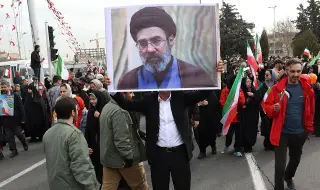
The election of Mojtaba Khamenei - son of the late Iranian supreme leader Ayatollah Ali Khamenei, as the new supreme leader, is a major topic in the Western press.
The hard-line Mojtaba Khamenei, who is close to the Revolutionary Guards, has succeeded his father as Iran's supreme leader, writes the French newspaper "Figaro".
Mojtaba Khamenei was appointed as the new supreme leader of Iran in a challenge to (US President Donald) Trump, writes the "Times". Hardline clerics have chosen Mojtaba Khamenei to succeed his father, Ayatollah Ali Khamenei, as supreme leader, the British publication points out.
A defiant Iran is turning to Khamenei's son, writes the "Daily Telegraph". According to the British daily, this choice will anger Trump, who has said that any new leader of Iran chosen without his approval "will not last long".
Iran's mysterious new leader used to hate America, and now things are on a personal basis, writes the "Daily Telegraph" Washington-based reporter Benedict Smith. Mojtaba Khamenei is unlikely to extend an olive branch to Donald Trump, Smith predicts.
Mojtaba Khamenei, 56, is expected to continue to lead Iran in the style of his father, writes the "Independent". He was elected supreme leader, although both he and my father were resolutely opposed to the idea of heriting power, the British publication notes. According to the "Independent", his election is expected to provoke controversy, taking into account that the Islamic Republic presents itself as an alternative to the monarchy of the Pahlavi dynasty.
The election of Mojtaba Khamenei as supreme leader could lead to an escalation of the war, after Donald Trump has already described it as unacceptable, writes the "Guardian". The British newspaper notes that the election of Mojtaba Khamenei is the first time since the Islamic Revolution in 1979 that the power of the supreme leader has been passed from father to son. This development, the Guardian points out, is likely to provoke a debate in Iran about the emergence of a dynastic system in a country based explicitly on the overthrow of the hereditary power of the Shah.
For his supporters, Mojtaba Khamenei symbolizes continuity with the ideological line, the beginning of which was laid by Ayatollah Ruhollah Khomeini and which was continued by his father, the Guardian also writes. Critics say his rise raises uncomfortable questions about the concentration of power and the possibility of hereditary leadership in a country founded by a revolution against the monarchy.
The election of Mojtaba Khamenei as supreme leader sent a strong message of opposition to President Donald Trump, writes the "Washington Post".
Mojtaba Khamenei has long been considered a leading contender for supreme leader, but there were initially reservations about his candidacy given that he is the son of the late ayatollah, the American publication points out.