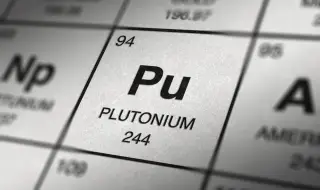
In the race with Nazi Germany to develop nuclear weapons on December 14, 1940, American scientist Glenn Seaborg decided on a fateful experiment: at the Radiation Laboratory at the University of "Berkeley" in California, USA, he irradiated radioactive uranium-238 with deuterons - heavy hydrogen. During the experiment, the decay of atomic nuclei produced a small amount of shiny, silvery radioactive material - plutonium.
Seaborg and his colleagues Kennedy, Macmillan and Wall realized that they had actually managed to isolate a new chemical element. The discovery was named after the planet Pluto, then still considered the most distant in the solar system, which in turn bears the name of the god of the underworld. The choice of a name - as far-fetched and somewhat ominous as possible - gives an idea of the potential that nuclear physicists attributed to the new element.
The military also quickly realized the enormous potential: since experiments with plutonium were part of the American "Manhattan" project to develop nuclear weapons, the discovery remained a secret until the end of the war.
How dangerous is plutonium?
Plutonium (Pu) is a heavy metal and, like other heavy metals, such as lead and mercury, is chemically toxic. Above all, however, plutonium is radioactive and emits alpha radiation when it decays. Unlike gamma rays, alpha rays cannot penetrate human skin. The radiation also does not have a long range. A sheet of paper is enough to block alpha rays.
However, if plutonium enters the body, the consequences are fatal. "Plutonium is most dangerous when inhaled", says the German Federal Office for Radiation Protection. Even a particle the size of a speck of dust can be deposited in various places in the body and cause serious diseases such as lung cancer, bone cancer, liver cancer and leukemia.
Plutonium also has a very long half-life, which means that it remains radioactive and dangerous to the environment for a very long time. The radiation risk from plutonium decreases very slowly due to the natural decay process - the isotope Pu-239, for example, has a half-life of about 24,110 years.
How much plutonium is there?
Plutonium occurs only in small quantities in nature - in uranium minerals such as carnotite, monazite and fergusonite. Plutonium is mainly produced artificially - in nuclear reactors, as a by-product of energy production.
If the uranium-238 used as fuel is exposed to a neutron flux in the fuel rods, a very small part of the uranium is converted into plutonium. To date, about 1,000 tons of plutonium have been produced worldwide for both civilian and military purposes.
Is plutonium suitable for nuclear power?
Plutonium has a high energy density and even small amounts can release a large amount of energy.
In theory, plutonium can also be extracted from spent nuclear fuel during its reprocessing and reused as fuel in reactors. This works in various types of reactors - both light water reactors and fast neutron reactors, also known as breeder reactors. However, its processing and use as fuel are associated with enormous challenges.
How plutonium became a deadly weapon
Plutonium was first produced on a large scale in a race against time: the "Manhattan" project, led by physicist Robert Oppenheimer, aimed to prevent the Nazi regime in Germany from acquiring a working atomic bomb before the United States.
High-purity plutonium-239, so-called weapons-grade plutonium, is used for military purposes. For a plutonium bomb to function, the Pu-239 content must be at least 93%.
The first test bomb, detonated in the New Mexico desert on July 16, 1945, was an implosion bomb with a plutonium core. The first atomic bomb used in combat - the one over Hiroshima - was uranium-235. Plutonium was used three days later, on August 9, 1945, in the "Fat Man" bomb dropped on Nagasaki. It contained 6.4 kilograms of plutonium as fissile material and had an explosive force equivalent to 21 kilotons of TNT. Within seconds, this bomb killed about 60,000 people on the spot and destroyed about 80% of the city. Many of the residents died later from radiation.
After World War II, tensions between the United States and the USSR led to a nuclear arms race. The Soviet Union began industrial production of plutonium as early as 1948. In 1949, the USSR tested its first atomic bomb - a plutonium implosion bomb.
A bright future for this dark element?
Nuclear weapons require plutonium or enriched uranium. This is one of the reasons for the construction of uranium enrichment facilities and civilian nuclear reactors during and after the Cold War.
At the height of the Cold War, the United States and the Soviet Union possessed a combined total of about 70,000 nuclear warheads with an explosive force equivalent to more than 800,000 Hiroshima-sized bombs.
Today, plutonium is largely "obsolete" - only a small fraction of the world's estimated 12,000 nuclear weapons use plutonium as a fissile material. Highly enriched uranium is more readily available for nuclear weapons production and is less hazardous to process than plutonium.
The traces of plutonium that can be found in the environment today come almost entirely from radioactive fallout from ground-based nuclear weapons tests between 1951 and 1962, when about 4 tons of plutonium were released into the atmosphere. According to the Federal Office for Radiation Protection, traces of plutonium found in food are so insignificant that they are considered harmless.
Author: Alexander Freund