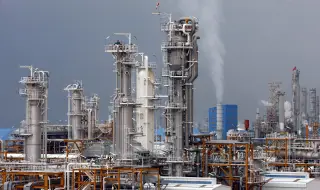
Iran has stepped up its attacks on oil and gas facilities in the Persian Gulf in retaliation for Israel's attacks on Iranian gas fields, significantly raising the stakes in the war, the Associated Press reports on the 20th day since the start of the conflict, BTA reported.
The price of London-based "Brent" crude oil jumped to $118 per barrel today - an increase of more than 60% compared to February 28, when Israel and the United States began the war against Iran.
Exchange of attacks on energy infrastructure
Israel attacks "South Pars" - the Iranian part of the world's largest gas field. The field is being developed jointly by Iran and Qatar and is of strategic importance to the Islamic Republic, as it provides about 70% of the country's gas consumption. US President Donald Trump said on his social network "Truth Social" that the part of the field attacked by Israel was "relatively small", and added that the US and Qatar were not notified in advance.
Some experts believe that the purpose of the Israeli strike is to put pressure on Iranian leaders by making living conditions in the Islamic Republic unbearable for the population, notes the AP.
Trump indicated in his publication on "Truth Social" that Israel will not attack "South Pars" again, "unless Iran unwisely attacks a completely innocent country, in this case Qatar". In his words, in this case the US "will blow up the entire "South Pars" gas field with a force that Iran has never seen before".
Iran later launched strikes on liquefied natural gas facilities in Qatar. Iranian state television reported early this morning that an Iranian missile had hit the Qatari refinery at Ras Laffan. Qatari Prime Minister Sheikh Mohammed bin Abdulrahman Al Thani was quoted by Agence France-Presse as saying that the attack was proof that Iran was not only targeting sites linked to the United States.
Ras Laffan is Qatar's main center for the production and export of liquefied natural gas, and the Qatari prime minister stressed that with its strike, Iran was targeting a strategic site in the emirate itself.
The attack on Ras Laffan caused Qatar to expel two Iranian diplomats.
Qatar's Energy Minister Saad al-Kaabi announced that the Iranian attacks had destroyed 17% of his country's liquefied gas export capacity and warned that recovery could take up to five years.
Meanwhile, Kuwait reported that two of its refineries had been attacked with drones and that the strikes had caused major fires.
The Saudi port city of Al-Qatar was also attacked Yanbu, which is currently the country's only export channel for crude oil. According to Reuters, an oil industry source, the strike targeted the SAMREF oil refinery. Damage to the facility was reportedly "minimal".
An Iranian missile struck an oil refinery in the northern Israeli city of Haifa, but the Israeli Energy Ministry said there was no significant damage to the facility.
Iranian Foreign Minister Abbas Araghchi warned that his country would show "no restraint" if its energy facilities were attacked again.
France, Britain, Germany, Italy, the Netherlands and Japan condemned Iran's attacks on civilian energy infrastructure in the Persian Gulf and said they were "ready to cooperate to ensure security in the Strait of Hormuz.".
Israel continues its attacks on Iran and Lebanon
The Israeli Air Force said it had carried out large-scale bombings against Iranian warships and infrastructure in The Caspian Sea in northern Iran. Israeli military spokesman Nadav Shoshani said Tehran's naval forces in the area had already been destroyed.
The Lebanese National News Agency reported that Israeli fighter jets carried out massive strikes in southern Lebanon today, hitting residential and agricultural areas. Two Russian journalists were also wounded in the attacks. Moscow said it was a "deliberate strike".
According to the latest figures from the Lebanese Health Ministry, the number of victims since the renewal of the war between Israel and the pro-Iranian movement "Hezbollah" on March 2 has already exceeded 1,000, with early estimates at least 2,584, Agence France-Presse reported.
The United States again comments on the goals of its war against Iran
US General Dan Kaine told a news conference that US naval forces were pursuing Iranian ships in the Strait of Hormuz, striking Iranian drones and dropping 5,000-kilogram bombs on underground weapons depots. Kaine said the US had struck more than 90 targets on Kharg Island, a key terminal for Iranian oil exports.
US objectives in the war against Iran have not changed, US Defense Secretary Pete Hegseth said at the same news conference. He recalled that these include destroying Iranian missile launchers, the defense industrial base and the naval forces of the Islamic Republic, as well as preventing Tehran from acquiring nuclear weapons.
Meanwhile, the head of the US National Intelligence Service, Tulsi Gabbard, told a hearing before the House Intelligence Committee that the US and Israel have different goals in the military campaign against Iran. "We can see from the operations that the Israeli government has focused on neutralizing the Iranian leadership. "The president (Donald Trump) has said his goals are to destroy Iran's ability to launch ballistic missiles, its ability to produce ballistic missiles and its naval forces," Gabbard said, quoted by Reuters.
A senior Pentagon official told the AP that the US military is seeking an additional $200 billion for the war with Iran.
Threats to global trade growth
The World Trade Organization (WTO) today published a new report on the outlook for global trade. The text states that a significant slowdown in world trade in goods is expected this year, with growth likely to reach only 1.4% - significantly less than the 4.6% increase in 2025, if energy prices continue to rise due to the war in the Middle East.
The WTO economists also note that there is a possibility that growth in trade in goods could be higher than expected if the war in the Middle East ends quickly and if trade related to artificial intelligence remains at high levels in 2026-2027. In such a case, growth could reach 2.4% this year and 2.7% in the coming year 2027.