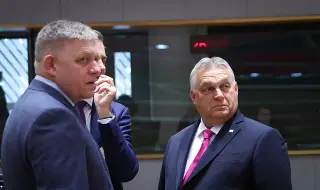
Europe's growing failures in foreign policy - from Ukraine's financing difficulties to the fragmented response to the war with Iran - are revealing a systemic paralysis. are fueling calls for a fundamental rethink of the way the bloc conducts its diplomacy, Politico reports, citing nine EU diplomats, officials, lawmakers and experts.
The EU’s inability to make unified decisions, such as unblocking a €90 billion loan for Kiev, imposing sanctions on radical settlers in the West Bank and implementing measures against Russia, reveals systemic paralysis.
More than domestic processes are reportedly at stake: amid escalating conflict in the Middle East, Russia’s ongoing war in Ukraine and tensions in transatlantic relations, diplomats have stressed that the EU risks being left on the sidelines at a time when geopolitical decisions are being made faster than the system can process them.
Disappointment with the stalemate is surfacing. A growing group of countries, led by Germany and Sweden, are pushing for a sharp reduction or complete abolition of national vetoes that allow one capital to block the actions of the entire bloc.
"We must abolish the principle of unanimity in the EU on foreign and security policy by the end of the current legislative term, in order to become better able to act on the international stage and become truly mature partners," German Foreign Minister Johann Waddefull said. "All the experience we have gained in recent weeks with aid for Ukraine and sanctions against Russia points to this."
Swedish Prime Minister Ulf Kristersson recently noted that discussions about using qualified majority voting in foreign policy decisions "will arise again" among leaders. The pressure comes as Hungary – less than a week before his April 12 election - has repeatedly delayed major decisions, including a €90 billion loan to Kiev.
This has heightened concerns in other capitals that the EU's foreign policy performance could be held hostage by domestic politics. Even if Prime Minister Viktor Orban loses power, diplomats have warned that the underlying problem will remain, as the unanimity principle would allow any government to take on the same blocking role.
"There are serious problems with the way we make decisions," explained Spanish MEP Nacho Sánchez Amor, a member of the European Parliament's foreign affairs committee. "Every month a new issue arises that highlights this trend. We must react.“
Another group of countries, including France, Belgium and smaller member states that fear being suppressed, are staunchly defending the veto right, arguing that it is at the heart of their national interests.
“I think starting a debate on the unanimity rules in Europe right now would be the shortest path to real problems,” Belgian Prime Minister Bart De Wever told reporters in Brussels.
The media reports that there is almost complete agreement in European capitals on one point: the system is not working.
“Look at the sanctions against settlers in the West Bank - it is a complete disaster,” said a senior EU official. He was referring to widely supported plans to impose sanctions on extremist Israeli settlers blocked by Hungary. "26 of our 27 countries support this, even Germany is "for", but we can't do anything for one".
Recent institutional tensions have heightened the sense of fragmentation. European Commission President Ursula von der Leyen and EU foreign policy chief Kaia Kallas have clashed over who should take the lead in foreign policy. At the same time, French Foreign Minister Jean-Noël Barrot urged the Commission president to respect the limits of his role during a meeting of EU ambassadors.
Diplomats and officials, however, stressed that such battles for spheres of influence are a symptom, not the cause.
For many, the real problem is unanimity. Another senior EU diplomat pointed to a telling episode from 2022, when Hungarian Foreign Minister Péter Szijjártó participated in meetings of the EU Energy Council, where decisions are made by qualified majority.
"He was behaving as usual, throwing criticism in all directions", the diplomat recalls. But unlike foreign policy, Budapest could be outvoted. "He was shocked. He thought he was still in the Foreign Affairs Council", the diplomat adds.
With French President Emmanuel Macron and German Chancellor Friedrich Merz still at odds on the issue, think tanks and political parties are trying to steer the discussion. The center-right European People's Party has come up with proposals to change the architecture of the EU's foreign policy, calling in its 2024 manifesto for replacing the head of the EU's foreign policy department with an "EU foreign minister with the rank of vice-president of the European Commission" and to create a Security Council that would include partners such as the UK, Norway and Iceland.
Senior Fellow at the Carnegie Endowment, Stefan Lehne, also supports structural changes, including the return of the EEAS to the Commission and the creation of a European Security Council to respond more quickly to emerging threats, including drones and missiles from Iran.
"Many understand that our foreign policy structures are dysfunctional", Lehne explains. "The challenges in foreign policy and security have become completely different. And the lack of innovation in this area is strange".
He adds that the idea of integrating the EEAS into the Commission has some support, "namely in the office of the Commission President". Not everyone is convinced. “I think the Commission would like it very much”, notes a fourth EU diplomat on the subject of merging the structures, while a senior EEAS official rejected the idea more sharply.
For Sánchez Amora, the problem lies not so much in the structures as in the political will. “We need to use the fact that there are so many problems in decision-making to think seriously about this: let's bring together the Council, the Parliament, the Commission and the High Representative to discuss this”, he says, while warning against changing the treaties.
Others believe the diagnosis is simpler. “The fundamental problem has not changed, the fundamental problem of foreign policy is unanimity”, summed up one senior EU diplomat. “You could even create a thousand institutions. As long as you have unanimity, the system will never be able to function properly.“