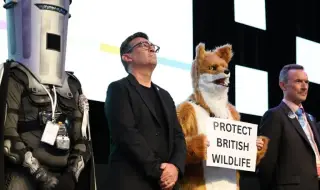
Andy Burnham and Keir Starmer are engaged in an open battle for the leadership of the Labour Party. Why does Burnham seem to many to be both better suited to be both party leader and prime minister?
In the last few weeks, Andy Burnham has toured the entire constituency of Makerfield in the Greater Manchester area, where a by-election was held. Labour politician Burnham is a local - among those on whose doorsteps he stands during his campaign is his former PE teacher, writes ARD. The strategy of talking directly to as many people as possible seems to have been successful - Burnham convincingly won the election. The result raised the question of whether Nigel Farage's "Reform UK" had not reached its electoral peak, but also a bigger question - that of the future of Prime Minister Keir Starmer.
In his conversations with voters, Andy Burnham heard many complaints about the Labour government and Keir Starmer. "Something needs to be done to solve the economic crisis, to make life more bearable - that's what people are saying," Burnham said after his victory in the election in Makerfield. He is well aware of the criticism on this issue, the German public media outlet points out. In 2017, he first ran for mayor of Manchester and said that the Westminster system was not working - it didn't function, it didn't look after ordinary people. In Northern England, this is a problem that locals are painfully aware of.
A traditional political career, but against the status quo
Burnham has two brothers who are teachers. He himself studied at a Catholic school, ARD reports. Asked what is truly important to him in life, apart from his family, he answers: Everton football club, the Labour Party, the Catholic Church - in that order. Burnham is married and the father of three children.
The former mayor of Manchester received his higher education in Cambridge, then worked briefly as a journalist, then as an assistant to a Labour MP. Burnham was 31 years old when he became an MP. Just a few years later, he was already Secretary of State. This is a classic political career - although Burnham has consistently shown himself to be an opponent of the system.
Third attempt after two failures
Burnham has tried twice to win the leadership of the Labour Party - once in 2010, and then in 2015. Both attempts were unsuccessful. That is why Burnham decided to run for mayor of Manchester in 2017, when he won and was re-elected twice more. Since then, he has achieved a lot in the region, comments John Tonge, professor of political science at the University of Liverpool.
The Manchester area has seen an economic boom in recent years, writes ARD. That is why Burnham can now safely say that he is the man who can take care of the whole of Britain, according to Tonge. "He will say he will apply the Manchester model to the rest of the country," the political scientist predicts.
Panic among Labour
Whether this will be easy is another matter entirely, notes the German public media. Burnham cannot influence the global economic crisis - the war in Ukraine and the stagnant situation in which many of the G7 countries find themselves. If he succeeds in becoming Prime Minister of Great Britain, Burnham will also have to deal with the consequences of Brexit. All of these are difficult tasks.
However, he has the air of a leader, emphasizes the ARD. Keir Starmer had a good career in the times before his election as Prime Minister, but somehow failed to convince the voters and therefore now faces extremely high expectations. Therefore, many in the Labour Party see Burnham as the leader of the party and a Prime Minister who may be their last chance to stop the rise of Nigel Farage's right-wing populists. The next general election is not until 2029, but panic is already being felt within the ranks of the Labour Party.
Starmer now faces a key decision - whether to hold an internal party election for the party leadership or to give up the prime ministership without that formality. He has already been advised by many of his cabinet ministers to step down, especially after the defeat that Labour suffered in the local elections.