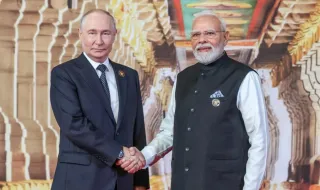
BRICS leaders gathered in New Delhi for the key part of the grouping's 18th summit, amid wars in Ukraine and the Middle East, tensions between major powers and attempts by emerging economies to increase their influence in the global financial and political system.
Among the most closely watched participants are Chinese President Xi Jinping and Russian President Vladimir Putin. The Chinese leader arrived in the Indian capital on Saturday. This is his first visit to India in seven years and comes amid a gradual thaw in relations between Beijing and New Delhi after a serious border clash in 2020.
Xi Jinping: BRICS should be a force for peace
In his speech in New Delhi, Xi Jinping called on the BRICS countries to play a leading role in maintaining world peace and stability.
The Chinese president paid particular attention to the ongoing crisis in the Middle East and the Persian Gulf region. According to him, the countries of the union should contribute to restoring peace and tranquility in the region.
Xi called on the BRICS to stand on the “right side of history“ and use its growing international influence to politically resolve conflicts and reduce global tensions.
The message is consistent with the position that Beijing put forward just before the meeting. The Chinese Foreign Ministry said that BRICS should uphold multilateralism, promote dialogue and enhance the role of the Global South in international relations.
Xi's presence in New Delhi also has significant bilateral significance. He is scheduled to hold talks with Indian Prime Minister Narendra Modi. This will be their third meeting in three years, and Beijing has already said it is ready to manage differences with India and develop relations from a “strategic and long-term perspective“.
Putin: The world economy is undergoing a structural change
Vladimir Putin used the BRICS forum to present Russia's case for a shift in the center of gravity of the world economy.
According to the Russian president, traditional economic powers are gradually losing their relative weight, while emerging economies are increasing their contribution to global growth.
Putin said that the BRICS countries now account for about 40% of world GDP, measured in purchasing power parity, while the G-7's share is approximately 29%.
The Russian president called on BRICS to move from political coordination to more practical economic cooperation in areas such as technology, infrastructure, investment and international payments.
According to him, the organization should build a platform for global economic growth that does not depend on the rules and restrictions imposed by Western countries.
Putin sharply criticized Western sanctions and trade restrictions. According to him, competition in the global economy has taken on increasingly aggressive forms, including through sanctions, restrictions on transport corridors and pressure on international supply chains.
This is the position of the Russian president. Some Western countries, in turn, define the sanctions against Russia as a response to the Russian invasion of Ukraine.
Putin and Modi: trade, energy, defense and nuclear cooperation
An important element of the meeting in New Delhi are the bilateral talks between Vladimir Putin and Narendra Modi.
The two leaders met on the eve of the main BRICS session and agreed to deepen the long-standing strategic partnership between Russia and India.
Official information from the Indian government shows that the talks covered trade, energy, defense, space cooperation, industry and mobility of skilled workers.
Among the areas discussed are also nuclear energy, critical minerals, rail transport, manufacturing and fertilizers.
Moscow and New Delhi continue to work towards the goal of their bilateral trade reaching $100 billion by 2030.
Modi reiterated to Putin India's position that international conflicts should be resolved through dialogue and diplomacy and that New Delhi is ready to support peace efforts.
The two leaders also discussed the international situation, including the conflicts in Ukraine and the Middle East and their impact on energy markets, maritime trade and supply chains.
BRICS agreed on a joint declaration
Meanwhile, Reuters reported, citing four sources, that the BRICS countries had managed to agree on a draft joint declaration.
Achieving consensus was not easy due to differences among individual members, especially regarding the conflict in the Persian Gulf and the opposing positions of Iran and the United Arab Emirates.
According to Reuters, the declaration is expected to condemn the unilateral initiation of war by any country, without naming specific countries.
This is an important test for the expanded BRICS. The organization already brings together countries with very different foreign policy interests, relations with the United States and positions on the wars in Ukraine and the Middle East.
BRICS seeks greater weight in the world order
The meeting in New Delhi also shows the organization's broader ambition. The BRICS countries are pushing for greater representation of developing economies in international institutions, including the United Nations, the International Monetary Fund and the World Bank.
Among the topics discussed are trade, investment, energy and food security, technology and the use of national currencies in international payments.
But differences remain among the core members. China and Russia see BRICS as a tool to limit Western dominance in the world system, while India emphasizes that the organization should not become an anti-Western bloc.
That is why the meeting between Modi, Putin and Xi is among the most important diplomatic events of the forum. The three represent countries with enormous economic and political weight, but also with different interests.
The first hours of the meeting show a common line on one issue: BRICS wants a greater role for developing countries in setting the rules of world politics and economics. Whether its members can translate this desire into common practical solutions will become clearer after the adoption of the final declaration.