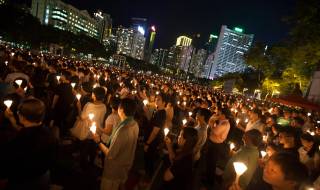
The Tiananmen Square Massacre, Beijing in 1989, also known as the 1989 Tiananmen Square protests, or the June 4 Incident, 1989, was a series of demonstrations led by students, intellectuals, and labor activists in the People's Republic of China that resulted in about 10,000 injuries and 2,000 deaths, mostly students and young people.
In the late 1970s, Chinese leader Deng Xiaoping initiated a series of economic and political reforms that led to the gradual introduction of a market economy in the country, as well as some political liberalization of Mao Zedong's system. These economic and political reforms provoked the discontent of two social groups in China in early 1989.
The first group includes students and intellectuals, who believe that the reforms have not gone far enough and that China needs to reform its political system. Since the economic reforms only affect farmers and industrial workers, the incomes of intellectuals lag behind those who benefit from the reforms. They are also dissatisfied with the social and political control that the Chinese Communist Party continues to impose. In addition, this group closely followed the political liberalization "Glasnost" initiated at the time by the leader of the former Soviet Union, Mikhail Gorbachev.
The second group were urban industrial workers, who believed that the reforms had gone too far, leading to a loosening of economic control, with the resulting inflation and unemployment threatening their livelihoods.
The 1989 Tiananmen Square protests were triggered by the death of former General Secretary Hu Yaobang. Hu had been removed from his post as General Secretary of the Chinese Communist Party (CCP) in 1987 when his calls for "rapid reform" and his almost open disregard for the Maoists made him a suitable scapegoat for Deng Xiaoping and his cronies after the pro-democracy student demonstrations of 1986–87.
The 1989 protests began on a small scale, in the form of mourning for Hu Yaobang and demands that the CCP revise its official stance on him. These protests grew as news of confrontations between students and police spread; the students' belief that the Chinese media was distorting the truth about their demands also contributed to the growing support they received from the population.
At Hu Yaobang's funeral, a large group of students gathered in Tiananmen Square and demanded a meeting with Premier Li Peng, Hu's political rival. The students thus declared a strike in Beijing's universities. On April 26, an editorial in the national daily People's Daily, following Deng Xiaoping's speech to party insiders, accused the students of plotting to cause unrest. This statement outraged the students, and on April 29, about 50,000 students took to the streets of Beijing to demand that the government withdraw its statement.
This appeal was attended by the majority of students in Beijing's numerous colleges and universities, and they received the support of their professors and other intellectuals. Viewing themselves as Chinese patriots, the students rejected the official CCP-controlled student associations and established their own autonomous associations.
Although the government declared martial law on May 20, the military entrance to Beijing was blocked by a large number of protesters and the army was ordered to withdraw.
Meanwhile, the demonstrations continued. The hunger strike that had been started earlier was approaching its third week, and the government decided to end the matter before the deaths began. After discussions with the leaders of the Communist Party, an order was given to use military force to resolve the crisis - an order was issued to suppress the demonstrations by the People's Liberation Army of China. Because of the expressed support for the student demonstration, the leader Zhao Ziyang was removed from the political leadership.
Soldiers and tanks from the 27th and 38th armies were sent to establish control over the city. Unlike the well-armed 27th army, which arrived from outside, the local 38th army lacked ammunition and sympathized with the protesters. Its soldiers abandoned their military vehicles on the streets of Beijing and joined the protesters.
The entry of the 27th Army soldiers into the city was actively obstructed by many local residents of Beijing, the website Awakening Era recalls. They built extensive barricades that slowed down the army's movement. The battle continued in the streets surrounding Tiananmen Square, with protesters repeatedly advancing towards the heavily armed People's Liberation Army soldiers, erecting barricades with vehicles to protect themselves from the army's gunfire, which was firing directly into the crowds and even using flamethrowers.
After the demonstrations in Beijing were suppressed on June 4, protests continued to flood other parts of China for several days. Hundreds of thousands took to the streets in Hong Kong, where people wore black, again in protest. There are major protests in Guangzhou and Shanghai.
Today, the topic of the Tiananmen Square massacre is still a political taboo in China, where any discussion of it is seen as inappropriate or risky.