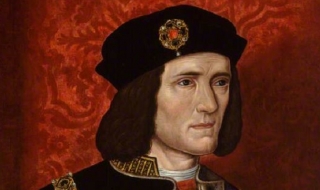
On August 22, 1485, King Richard III dies in the Battle of Leicester. He is buried in a nearby monastery.
His grave was discovered in 2013. The death of the monarch, whose dark image has remained in history thanks to the genius Shakespeare, ends the Hundred Years' War.
He was 32 years old when he died at the Battle of Bosworth in 1485. He was then buried at the base of the altar of the church of the nearby Franciscan monastery.
However, the new monarch Henry Tudor ordered the destruction of Richard III's tomb and his body to be thrown into the River Sor, which flows through Leicester.
According to legend, the monks replaced the royal remains and threw the body of a dead homeless man into the water. In the 16th century, the monastery declined, and with it the memory of Richard III's tomb was lost.
On March 27, 2015, King Richard III was buried in an extremely solemn ceremony in the cathedral of the British city of Leicester.
The monarch was laid to rest in a tomb worth $5 million.
Richard III Gloucester was born on October 2, 1452. He is the eleventh of twelve children of Richard of York and Cecily Neville.
He is weak, even skinny, lame, and because of his physical defects at birth, they began to call him Hunchback. Despite this, he has inexhaustible energy and takes part in many military campaigns. He is recognized as an excellent strategist, and is also distinguished by his courage and valor. Richard loyally serves the King of England - the eldest of his brothers, Edward IV, demonstrating not only the skills to fight battles, but also to cope with no less complex administrative challenges. And yet, arrogance, ambition and envy rage in him. He does not want to remain a secondary figure among the Plantagenet dynasty.
After the death of his brother, his 12-year-old son Edward is recognized as king. Richard swears allegiance to Edward V, but at the same time begins to brutally deal with the relatives of the minor monarch. The Privy Council of the kingdom declared Richard Lord Protector of England and Regent of the King. On the day of the young king's coronation, Richard managed to convince both Parliament and the people that the marriage of Edward IV and Elizabeth was illegal, and therefore their children could not inherit the crown.
On June 25, 1483, Parliament dethroned Edward V and proclaimed Richard III king. After that, Edward and his younger brother were imprisoned in the Tower, and a little later they literally disappeared. It is believed that they were murdered. The barbaric act was, of course, attributed to their uncle Richard III, which not only did not make him more popular, but also earned him new enemies, and many of his former allies abandoned him.
In 1485, Henry Tudor, Earl of Richmond gathered a not very large army in France - 1,500 mercenaries and 500 Englishmen, who had fled earlier when the new king ascended the throne. Henry crossed over to the Isle of Man with this army and met Richard in a fateful battle. The battle took place on August 22, 1485 near Bosworth. The troops led by Richard had numerical superiority, but the king was unexpectedly betrayed by one of his vassals - Lord Stanley, who at the last moment went over to the side of the rebels.
The crown of England was placed on the head of Henry Tudor on the battlefield. This ended the decades-long Wars of the Roses, in which the Houses of York and Lancaster contested control of England. The male line of the Plantagenets was cut short by the death of Richard III, and Henry VII laid the foundations for the new Tudor dynasty.