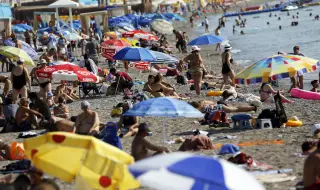
It seems that the days of cheap holidays in Turkey are over. Many hotels, restaurants and cafes - both on the Aegean coast and in Istanbul - have significantly increased their prices, ARD notes. In June, prices for hotels, restaurants and others rose by 36 percent compared to the same month the previous year, according to data from the Turkish Statistical Institute.
Many tourists are giving up on holidays in Turkey
Holidays on the Bosphorus are becoming more expensive, and this has also affected tourists from Germany. Travel agencies in the country say that there is a decline of about ten percent in demand for holidays in Turkey this summer.
The effects on the Turkish economy are visible. Tourism accounts for up to 13% of the economy, says Kathrin Pasvantis of Germany Trade & Invest, Germany's foreign trade promotion agency: "Tourism has a significant impact on the entire economy. When you consider that it brings foreign currency into the country and creates jobs," says Pasvantis. Tourism stimulates sectors such as gastronomy, transport and retail.
The Turkish lira continues to collapse
One positive thing for travelers to Turkey is the country's weak national currency, writes ARD. The Turkish lira has lost a lot of its value - one of the reasons for this is Erdogan's monetary policy. For a long time, he refused to raise interest rates, contrary to economic theory. This only fueled inflation in the country.
Two years ago, the Turkish Central Bank raised its main interest rates in an attempt to control inflation. Currently, the main interest rate of the Turkish Central Bank is 46%, loans are becoming more expensive for companies and consumers, and the state debt is also growing.
Inflation is falling, but too slowly
Many tour operators are already taking out insurance and negotiating prices in euros, which means that tourists cannot save on the cheap Turkish currency. The high inflation in the country is also decreasing slowly - in June it officially amounted to 35%, ARD writes. Independent experts from the research group "ENAG", however, doubt these data and assume that the real appreciation is twice as high. Financial markets were further shaken by the arrest of Istanbul Mayor Ekrem Imamoglu. The lira's decline has accelerated further.
The central bank continues to intervene, explains currency expert Antje Prefke of "Commerzbank". "The central bank is trying to "lirize" the economy. The goal is to use fewer euros or dollars." By using foreign exchange reserves, the central bank is trying to stabilize the currency, Prefke says. "But because of that, the level of reserves doesn't look good at all."
The economy is floundering
Former investment banker Mehmet Simsek was supposed to restore people's trust in financial institutions when he took over as finance minister. But the economy continues to struggle. Turkish President Recep Tayyip Erdogan also insists that the Turkish economy should be interest-free. However, the markets are not buying these ideas. "Erdogan is clearly refusing to accept the drastic and painful changes in the economy", commented economist Prefke.
The markets lack confidence in the conditions of high inflation, rising minimum wages and political uncertainty. Many are withdrawing their capital from Turkey - which is also visible in direct investments. Even the stock market is not performing particularly well compared to international indices, notes ARD.
Companies are refraining from investments
German companies that had planned to invest in Turkey are now hesitating, says Kathrin Pasvantis of the Foreign Trade Promotion Agency. "Companies say they want predictability", she explains. The unpredictable conditions in the Turkish market are poisonous for investors.
The situation in the Middle East is also very unpredictable and creates distrust in investments in the region. All of these events continue to impact the Turkish economy, as well as tourism in the country. This trend is likely to continue for some time.
Author: Konstantin Röze