Adv. Kostov, what is the essence of the dramas that are developing around the Council of Rectors and what is happening with the organization of Bulgarian higher schools and universities?
Currently, the Council is subjected to unprecedented external pressure in its history, which uses relatively weak and vulnerable university units to try to delegitimize the association publicly and replace its function and role. These attempts are escalating and, as you can see, the creation of a convenient quasi-structure is already being initiated, which is designed to say “yes” to attempts to politically subjugate the higher education system. This is not something new for us, academics. In the past, such attempts have been made many times. Universities currently need to show firmness, resistance to pressure, wisdom and patience in order to resist. I believe that their leaders will show that they are once again stronger than the “strong” of the day.
Is it true that over 30 universities want the creation of this new structure?
This is manipulation. The number of members of the Council of Rectors is legally limited to the number of higher education institutions in the country, which is currently 51. If over 30 universities want to create some new organization - let them command and manage the current one, since this number is a clear majority. In academic relations, including and respecting the point of view of those who think differently is a guiding principle. The Board of Directors and other bodies of the association have repeatedly reached out to their colleagues in recent months and called on them, in the name of good academic tone and preserving the authority of Bulgarian higher education, to hold the desired debate within the existing structure. This was also requested by the rectors and deans - the people who led the Council and participated in its management for three decades. These appeals have obviously not been heard.
Why is such a conversation rejected and claimed to be impossible?
When the phrase "the opportunity for dialogue has been exhausted" appears in academic relations, be very careful. In university circles, the opportunity for dialogue is never exhausted by definition. This is the main academic "weapon" since the times of Plato and Aristotle. It is obvious that an agenda imposed by external forces is being followed, which must be implemented, and which aims not only to control the Council of Rectors, but also to deconstruct and publicly delegitimize it. In this way, its authority, recognition, trust formed over the years, its international contacts, accumulated expertise and partnerships with public and private institutions are being erased.
What gives you grounds for such serious accusations and who are they aimed at?
To the politicians and so-called “public figures“, who initially engineered the creation of the Association of State Higher Education Institutions, which your editorial office itself defined as a “disposable association“, as well as to their progressive successors, who, after 33 years, during which no national or international institution, both from the public and private sectors, found legal problems in the activities of the existing Council of Rectors, “suddenly“ since the beginning of June this year “they saw“ insurmountable obstacles to it continuing to fulfill its role as a communicator and defender of the interests of universities before the state.
Would you comment on the allegations of legal problems with the status of the organization, which were recently publicly voiced by Prof. Dimitrov – Rector of the UNWE?
Trying to claim that black is white is very offensive and means that you have no arguments to publicly legitimize your real intentions. There are no legal problems with the status of the Council of Rectors, which has existed since 1993, i.e. there is nothing lost to restore. The Council of Rectors is older than the Law on Higher Education itself, which normatively regulates the already existing organization as of 1999. This is clearly established by the transcripts of the debates in the National Assembly and the statements made at that time. Other prestigious internationally recognized organizations such as the Bulgarian Olympic Committee and the Bulgarian Red Cross are registered and exist in a similar way. Accepting Prof. Dimitrov's thesis also denies their legitimacy. It is so clumsily concocted with white threads that anyone who continues to use it should feel at least a little ashamed. In this regard, Academician Nikolay Denkov and Professor Daniel Valchev deserve much more respect, with whose ideas I do not agree, but who directly named the real problems and openly stated that they are neither legal nor personal, but political. Yes, the Council of Rectors is currently, and has been, inconvenient for the authorities, that is already clear.
Additionally, the authors of the idea of creating a new Council of Rectors point out the fact that it has deviated too much in its activities from the functions regulated in Article 23 of the Higher Education Act?
Here is the most interesting part. The problem was that the organization has membership fees, governing bodies, auxiliary committees, etc. However, these are all signs of a truly working and functioning structure. Do you know how much the membership fee actually is - 511 euros per year! Judge for yourself how big this amount is for an institution like Sofia University or the UNWE, for example. There should have been a single chairman, no management board and other bodies, because the Higher Education Act did not explicitly mention this. I ask rhetorically, when meetings of committees of the National Assembly and the Ministry of Education and Science are held at the same time, which happens constantly, where will this chairman be present? How will the opinions of the Council, which are dozens and cover a huge range of topics, sometimes requiring narrow expertise and an incredible amount of preparation, be compiled? What is this rector-superhero, who will be everywhere, at all times, will know everything and will be able to do even more? The above shows where the real problem actually lies - the organization during the mandates of Acad. Lachezar Traykov and Prof. Temelkova began to work effectively and became a major corrective to state policies. These policies are trying to rule by dividing - of large and small, of state and private, of research and other higher education institutions. Some of the universities and their puppeteers – politicians are hurting there. The Council of Rectors openly pointed out the shortcomings of the existing mechanisms and demanded their revision.
Do you still recognize the legitimacy of these statements and the demands of their authors?
In academic relations, every thesis is legitimate. However, it must be carefully analyzed and the authenticity and public support it receives must be assessed. It is here that the authors of the idea of a “second synod“ of Bulgarian higher education have a serious problem, because the thread of replacement is quite clearly visible. Starting with the Association of State Higher Education Schools, going through the elections for a new leadership in March of this year and arriving at the “discovery” that there is some phantom legal discrepancy between the body under Art. 23 of the Higher Education Act and the existing Council of Rectors. Note that it first appears in a letter from the rector of NATFA, who has gained popularity in the public sphere, on June 5 of this year, i.e. before the last meeting of the General Assembly of the association, held on the eleventh of the same month. This is a clear indication whether it is a matter of an occasion or a pretext through the departure of some of the rectors from this meeting. The entire campaign to “restore” the existing Council is a purposeful act in which rectors dependent on the government and politicians who are dissatisfied with the emancipation of the organization participate. Now, due to the scandals in NATFA, the baton is being taken over by another rector, which is sad and unfortunate. The path of universities must be completely different!
How will this new division in the Bulgarian public space end?
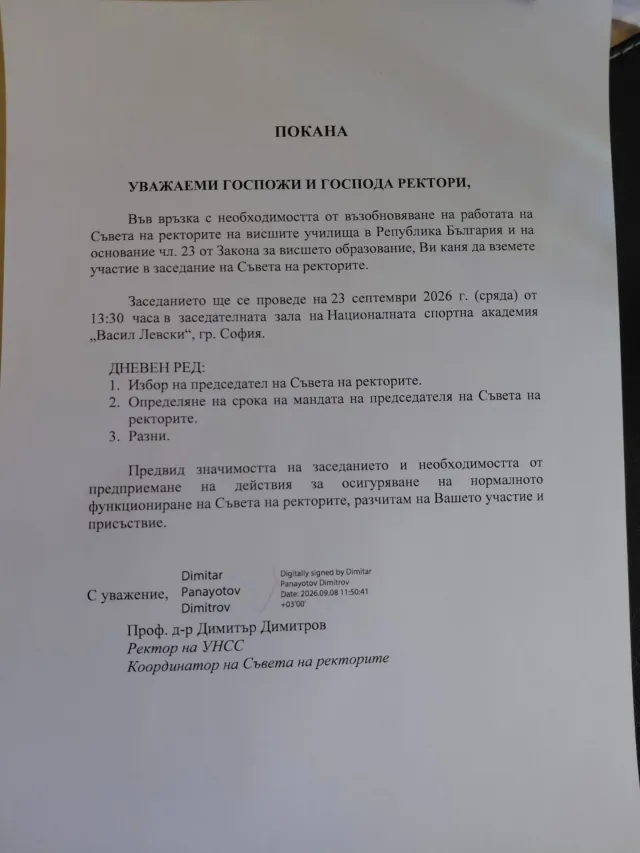
It depends on the wisdom of the university community. An invitation has been sent to all rectors to participate on September 23 in the NSA at a General Assembly, at which it is not planned to establish any new legal entity, but to “resume the work of the Rectors' Council under Art. 23 of the Higher Education Act“. What legal entity this Rectors' Council will be under Art. 23 of the Higher Education Act - is not specified. What is the fate and role of the existing and operating organization - is not stated. The actions of the initiators are motivated by “the significance of the meeting and the need to take action to ensure the normal functioning of the Rectors' Council“. If any lawyer reads this and can explain it, let him try. For me, the readiness of politicians and state institutions to recognize and legitimize these actions will show our maturity as a society and whether, as I suspect, an organized raid is being prepared, supported by some of them, including state institutions, to take over an autonomous, independent, internationally recognized academic organization.