



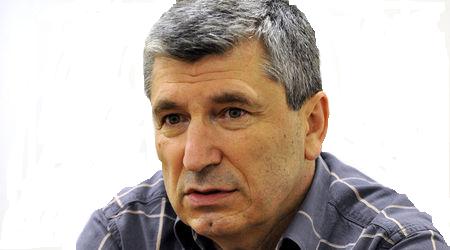
Kirill Budanov's visit to Sofia was kept secret for two reasons - security reasons and the Ukrainian side's desire not to publicly embarrass its Bulgarian hosts.
Both are telling.
The first means that Ukraine assesses the risk of Russian intelligence and operational structures in Bulgaria seriously enough to prevent any preliminary publicity surrounding the visit of one of the most important people in the Ukrainian security system.
The second is even more interesting.
Ukraine apparently wanted to hold a conversation with Bulgarian institutions without publicly forcing them to take a position that they themselves may not be ready for.
This is a diplomatic gesture.
And it shows something very important - Ukraine cares about relations with Bulgaria.
Moreover, it considers itself obliged to inform the Bulgarian state about what it knows about the attacks on ships in the Bulgarian exclusive economic zone.
Here, Budanov's role is not accidental.
He is a person from Zelensky's closest circle and has extremely sensitive intelligence information. Since January 2026, he has headed the Office of the President of Ukraine, with security and the negotiation process among his main tasks.
This is a person who knows a lot. And that is precisely why his presence in Sofia matters.
Ukraine clearly has information that it considers important enough to present to the Bulgarian government and president.
And here we come to the big problem.
How long can Bulgaria continue with the policy of “I didn't understand, I didn't see, I didn't hear“?
Two merchant ships were attacked in the Bulgarian EEZ. One sank. There are missing crew members. Ukraine claims to have information about the perpetrator. Bulgaria must establish the facts.
This is not a matter of sympathy for Ukraine. It is not a matter of a preliminary political decision as to who is guilty.
This is a matter of national security.
There is a huge difference between saying:
“Russia is guilty“ and say: “Give me the evidence and I will check it.“
The second position is the mandatory position of a state.
And it is here that President Rumen Radev faces an inevitable test.
He is not obliged to accept the Ukrainian version in advance.
But he is obliged to request, examine and evaluate the evidence.
And if the evidence points to Russia - to say so.
Because a statesman cannot choose facts according to the political cost of their recognition.
And this is precisely the danger of the policy of constantly postponing the obvious - each new fact becomes not a reason for updating the position, but a problem that must be politically circumvented.
And this is already very dangerous for Bulgaria.
Because Russia does not need Bulgaria to leave NATO and the EU. It is enough for Bulgaria to be a country that hesitates long enough to be unable to react in time.
And Bulgaria currently needs the exact opposite - institutions that see the threat, check the facts and make decisions regardless of political comfort.
For Iliana Yotova, the problem is even deeper. Because, in difficult situations, she lowers herself precisely because her entire career and professional path has been in the conditions of nomenclature diapers - without having to make difficult choices and defend them. Remember at least one time of showing character.
Intelligence can provide information. But the decision is up to the statesman. And he bears responsibility for it.
This is exactly what Bulgaria lacks at the moment - not information, but the confidence to use the information.
Not evidence, but a willingness to accept evidence when it destroys the convenient political construct.
And this leads to the real curse of Bulgaria.
In the most difficult and risky moment for our national security in recent decades, our country needs statesmen with their own judgment, political courage and a sense of responsibility. And they are not there. Neither president nor prime minister.
Because in a crisis, the most dangerous thing is not to be wrong.
The most dangerous thing is to refuse to see what you already know.