


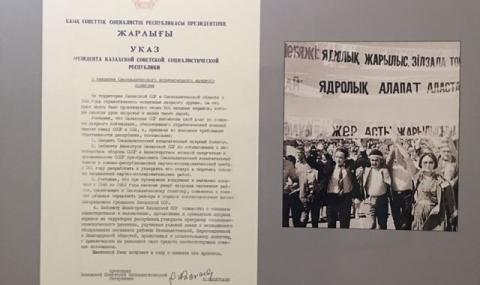

On this day, August 29, in 1991, the Semipalatinsk Nuclear Test Site was closed in Kazakhstan.
The Semipalatinsk Nuclear Test Site was established in 1947 by a decision of the USSR Council of Ministers.
On August 29, 1949, the first RDS-1 atomic bomb, with a capacity of 22 kilotons, was detonated at the test site. This terrifying sight was witnessed not only by military personnel and scientists, but also by ordinary people who became hostages of their time. As is known, nuclear charges were stored and tested on the test site, but the local population also lived there. There was nothing like it anywhere else in the world. Due to the imperfection of the nuclear charges of 64 kg of uranium, only 700 grams participated in the chain reaction, the remaining uranium simply became radioactive dust remaining after the explosion.
The mortality rate of newborns in settlements near the Semipalatinsk test site increased not only in the first, but also in the second generation. Child mortality increased 5 times. The average life expectancy in the region decreased by 3-4 years. In the irradiated population, the frequency of birth defects is 5 times higher than in the rest of the population. The residents of three regions of Kazakhstan suffered the most from the explosions: Semipalatinsk, Pavlodar and Karaganda.
Over the years of the test site's operation, 468 tests were conducted here, during which 616 charges were detonated, with a total capacity of nearly 38,000 kilotons, 125 atmospheric explosions and 343 underground explosions.
The total power of the nuclear explosions produced at the Semipalatinsk test site is approximately 1,000 times greater than the power of the atomic bomb dropped in 1945 over the Japanese city of Hiroshima.
The testing of atomic weapons was carried out not only in the airspace, but also underground, at the Balapan and Degelen sites.
After a leak of radioactive gases was recorded at the Semipalatinsk test site in February 1989, the famous Kazakh writer, poet, public figure Olzhas Suleimenov organized a protest in the capital of Kazakhstan, which was attended by thousands. 130 thousand miners from Karaganda - participants in the anti-nuclear movement - declared that if nuclear tests continued, they would go on an indefinite strike. The miners were supported by residents of Semipalatinsk, Pavlodar, Ust-Kamenogorsk, Zhezkazgan and many other cities. A delegation from the USA (Nevada State) arrived in Kazakhstan and joined a peaceful march, calling for a halt to nuclear tests worldwide. Thus, the anti-nuclear movement became international and was named "Nevada-Semipalatinsk". The last explosion on the territory of the test site was carried out on October 19, 1989.
On August 29, 1991, by decree of the President of the Kazakh SSR Nursultan Nazarbayev, the Semipalatinsk Nuclear Test Site was closed.
After the closure of the Semipalatinsk Test Site, Kazakhstan took another important step as a practical contribution to reducing the global nuclear threat - it voluntarily gave up the world's fourth largest nuclear missile arsenal.
The initiative to declare August 29 the International Day against Nuclear Tests, raised by the first President of the Republic of Kazakhstan Nursultan Nazarbayev, was unanimously supported by the adoption on December 2, 2009 by the UN General Assembly of Resolution No. 64/35, by which this day was declared the International Day against Nuclear Tests.
The first President of Kazakhstan Nursultan Nazarbayev initiated the project «ATOM». This international campaign aims to provide people from different countries with access to information about the consequences and threats of nuclear tests. Within the framework of this project, every person on planet Earth can put their electronic signature under the online petition to the governments of the countries of the world and thus strive for the conclusion of a treaty on a comprehensive cessation of nuclear tests.
On August 27, 2020, the Ministry of Foreign Affairs of the Republic of Kazakhstan announced that the first President of Kazakhstan Nursultan Nazarbayev received the status of “Champion for a World Without Nuclear Tests“ yesterday. This was announced at a special session of the UN General Assembly, organized on the occasion of the International Day against Nuclear Tests - 29 August.
The Executive Secretary of the Comprehensive Nuclear-Test-Ban Treaty Organization (CTBT) Lasina Zerbo initiated the assignment of this new status to Nursultan Nazarbayev in recognition of the historic contribution of Kazakhstan, during his leadership, to global efforts to build a nuclear-free world. Former President of Finland Tarja Halonen also received a similar status.
In addition to the Executive Secretary of the CTBTO Lasina Zerbo, the meeting was addressed by former President of Finland Tarja Halonen, civil activists from countries affected by nuclear tests - Karina Lester (Australia) and Selina Lim (Marshall Islands), as well as representatives of UN member states.
On the occasion of the International Day against Nuclear Tests, the Embassy of Kazakhstan, with the assistance of the State Cultural Institute under the Minister of Foreign Affairs of the Republic of Bulgaria, will hold an official opening of a photo exhibition at the “Mission” gallery at: Sofia, 2 Alfred Nobel Street. The exhibition can be visited from August 28 to September 9, 2020, every working day between 10 a.m. and 5 p.m.