


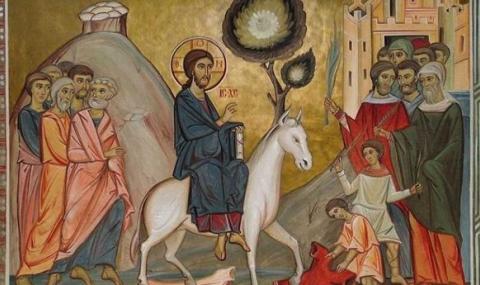

Palm Sunday is the last major church holiday before Easter. It is celebrated in both the Orthodox, Catholic and Protestant churches one week before Easter, on the Sunday after Lazarus Day. It is also called Palm Sunday, Palm Sunday, Vaya (Vaya), Kuklinden or (in Western churches) Palm Sunday.
Tradition connects it with the solemn welcoming of Jesus Christ in Jerusalem with palm branches, glorified as the Messianic King. He enters the city on a donkey and is greeted by the people with "Hosanna", for having resurrected Lazarus the day before - on Saturday. Solemnly welcomed in Jerusalem on Palm Sunday, he voluntarily walks, step by step, towards the predetermined end of his earthly life.
The people call the holiday Palm Sunday or Palm Sunday, Palm Sunday, Vaya, Kuklenden. Palm Sunday is the holiday of flowers and flowering. Everyone who bears the names of flowers, plants, shrubs and trees celebrates a name day: Camellia, Tsena, Tseno, Tsvetan, Varban, Vrbinka, Violeta, Zdravko, Zdravka, Lilia, Latinka, Ralitsa, Temenuga, Temenuzhka, Tsveta, Tsvetan, Tsvetanka, Tsvetelina, Yasen, Yavor.
Jesus entered Jerusalem on a donkey, the children rejoiced and laid palm branches before him with the words ”Hosanna to the Son of David! Glory to God in the highest!” Seeing the universal jubilation, the Pharisees and the chief priests were filled with envy and malice. They turned to Christ with the words: “Tell them to be silent,” and he answered them: “I cannot do this. If I do, the stones will cry out.” It seems that the hearts of the chief priests were harder than stone, since they were not moved by his entry into Jerusalem. When Christ realized that they wanted to proclaim him king, he withdrew to Bethany to spend the night, because he did not want earthly glory.
On his last entry into Jerusalem, Christ also went to the temple and overturned the tables of the moneychangers who exchanged coins and the merchants who sold various goods in the temple. He addressed them with the words: ”My Father's house is a house of prayer, and you have turned it into a den of robbers.” According to Father Harizanov, these words of his further embittered and embittered the high priests and Pharisees, who were looking for a reason to arrest him and destroy him a few days later.
On this day of the service in the temples, Christians hold consecrated willow branches in their hands, which replace the palm branches - as if they are welcoming their Savior again. Priests consecrate the branches and flowers brought by the believers. After the service, Christians take the consecrated willow branches to their homes for health and protection from illness and evil. Usually, wreaths are woven from them and hung over the threshold of the house or over the home altar.
On this day, Lazarus rites and customs continue. On this holiday, the cycle of maiden spring games ends with the kumichene of the lazars. In the evening, maidens and bachelors perform the lazar dance for the last time on the square, and for the first time since the Easter fast, the dance is concluded. In some regions of Bulgaria, memorial rites are also performed on this day, related to the belief that on Vrabnitsa the dead come out of their graves and expect their relatives to bring them something. Early in the morning, women go to cemeteries with willow branches, corn stalks, a censer and water. They incense and pour incense over the graves of their loved ones. Then they stick willow branches to the grave monuments and light a fire with the chaff (corn stalks).
Lazarus Day and Palm Sunday are always on the last Saturday and Sunday before Easter.
The main ritual role is played by the maidens. They sing and dance.
But this is not a celebration, but a fateful ritual. It is called lazaruvane. For the girls themselves, the rite is an “initiation” into maidenhood, into premarital age. It was once believed that a girl who had not lazaruvane could not marry. At the same time, the maidenhood ritual should bring economic and life prosperity to the entire village. That is why the lazar girls, although they are very young girls, are greeted with respect by all the residents. This significance of the lazar ritual has probably preserved it to this day. The rite itself is beautiful and vital. The custom is known in every Bulgarian village and region. That is why there are many local ritual variants. In some places, even the name is different. But the main elements are common. Each Lazar group must perform a cycle of songs, and in some places a dance, characteristic only for these holidays.
Once upon a time, the maidens would go around all the houses in the village with their ritual.
Today, in some villages, the ritual is only recreated on stage. But in many settlements, the custom is reproduced as it once was - the lazarki go around all the houses. The traditional meaning is that the lazarki bring their ritual blessing to every home for prosperity and the fulfillment of the most secret hopes for each member of the family. In the extensive ritual cycle of lazarki songs, there are appropriate texts for every age and social status. The images in these songs carry very ancient symbolism and sound particularly poetic. The maiden daughter is a spring flower or a star. The bachelor son is a lyrical hero on a beautiful horse and races with the sun. The father is presented as a mighty family tree. The children are a flock of doves.
There are also songs about the main occupations - from the farmer and the shepherd, to the goldsmith and the teacher.