


At an international competition in the heart of Bavaria - Munich, the team of the Technical University - Sofia proved that quality does not depend on the budget. Among five teams from Serbia, Spain, Germany and Bulgaria, our students prevailed with something that is difficult to buy with money - engineering precision and composure under pressure. With the most modest means of all the participants, they not only completed the task in a critically short time, but also turned out to be the only team whose drone landed in the same way it took off. The final ranking is third place, but the story behind it is much more interesting... Speaking to FACT, Georgi Petrov, a second-year student majoring in "Aviation Engineering and Technologies", Yordan Simov - a second-year student majoring in "Aviation Engineering and Technologies", and Alexander Malinov - a third-year student majoring in "Mechatronics".
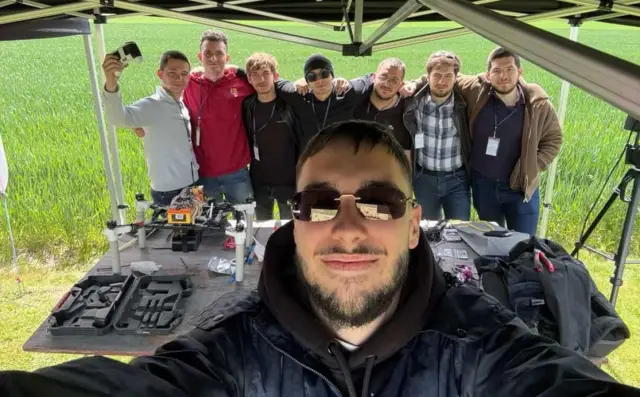
(b.r. – in the lead photo from left to right are: Atanas Pandeliev, Iliya Ivanov, Georgi Petrov, Yulian Petkov, Yordan Simov, Kristiyan Gergov, Antonio Petrolo and Alexander Malinov)
- Mr. Petrov, Simov and Malinov, what was the main task facing the participants in Rapid Response Challenge 2026 and what was the biggest challenge?
- Georgi Petrov: The first task was to develop a drone that met certain criteria in terms of size, weight and fins. The second task, which took place in Munich, was for this drone to pass through two different routes, while simultaneously carrying a shipment of certain dimensions.
- Alexander Malinov: In reality, the most difficult task was to achieve a balance between optimal characteristics and low price, but I think we coped with this challenge excellently!
- How much time did you have to prepare?
- Yordan Simov: We had four months, but we managed to fit it in a much shorter time.
- How did the competitors approach the creation of their drone?
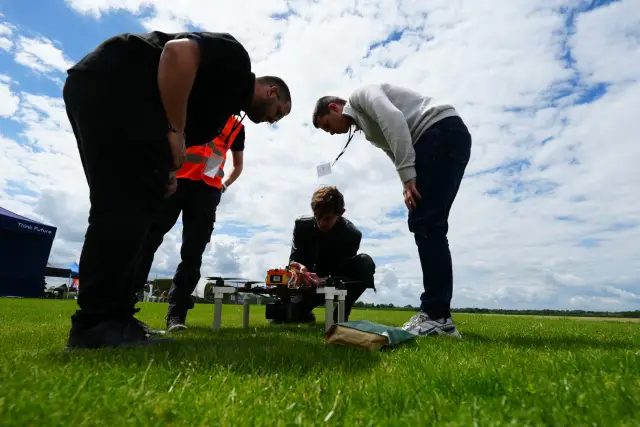
- G. P.: The odds were against us, as the other teams had huge teams and budgets. Our drone is made entirely of easily accessible materials – we are talking about 3D printed parts, square aluminum profile (we used it for the profiles of the drone's shoulders), G10 plastic. And the competitors used mostly custom-made parts – components that cannot be found quickly and easily.
- Al. M.: Later we found out that the team of one of the competing teams consisted of over 70 people, and others had a budget of over 30,000 euros.
- J.S.: For reference – our trip to Germany (Munich) was covered by the Technical University, and the construction of the drone itself cost us about 700 euros in parts. This amount also includes the battery, which was also purchased by the university. Thus, with relatively modest resources, we managed to win third place in the competition, which is a great success for us.
- Why did the organizers choose a scenario for a humanitarian mission with drones and to what extent does it reflect real situations that emergency services face today?
- Al. M.: The course was designed in such a way that the pilot was required to perform numerous maneuvers in an extremely short time, since speed turned out to be key in the awarding process. This shows that the organizers emphasize the drone's ability to reach hard-to-reach places in a minimum period of time.
- What were the biggest technical challenges facing the student teams in carrying out the simulated mission?
- G. P.: We cannot reduce the challenges to one or two. Each team experienced different difficulties in the competition. Some had difficulties taking off, others in carrying the shipment, others with the overall electronics, etc. The drone had to reach certain GPS coordinates and enter autonomous mode on its own. This means arriving, finding the final destination and landing on its own without the pilot's intervention.
- Y. S.: All the teams failed at this, and we simply didn't have enough time to make the software that was needed.
- To what extent are artificial intelligence and autonomous systems already changing the way unmanned aerial vehicles are designed and operated?
- G. P.: Artificial intelligence can do a lot of the work, but certainly not all of it. On the one hand, it can generate the software for the specific drone. On the other hand, artificial intelligence cannot take over the physical design and assembly of the mechanical parts. The thing we are far ahead of it in is the creativity we apply in crisis situations.
- Al. M.: When a certain problem requires a quick solution, artificial intelligence acts strictly according to the rules, but they do not always and not in all cases work.
- What skills do students acquire through such international competitions and is there real interest from the industry in the young engineers who participate in them?
- Y. S.: The most important skill that students acquire is teamwork. This turns out to be a difficult task, because each person has their own solutions, observations and views on a given problem, and accepting different points of view is not always as easy as it sounds. Naturally, everyone also gains valuable practical experience.
- G. P.: For many of them, this is the first real project that goes beyond the formulas given to them in textbooks and becomes something that can be physically touched and seen in action outside of simulation programs. The interest from the industry is great, although more focused on local competitors.