


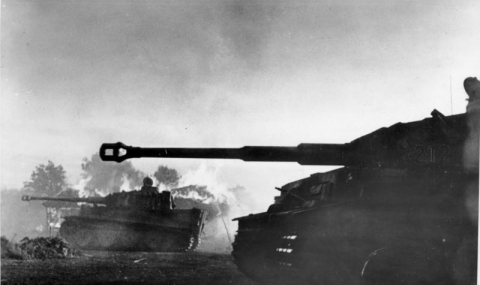

The Battle of Kursk was one of the major operations on the Eastern Front. It involved 4 million soldiers, 13,000 armored vehicles, 50,000 guns and 12,000 aircraft. It was the last major German offensive against the Red Army. Part of the Battle of Kursk was the largest tank battle in history.
The defeat at the Battle of Stalingrad (1942-1943) and the subsequent winter Russian offensive led to the formation of a salient in the territory controlled by German troops, about 192 km wide and 120 km deep around the city of Kursk.
Adolf Hitler saw in its reduction an opportunity to regain lost prestige and the lost strategic initiative. The Battle of Kursk was fought from July 5 to August 23, 1943, in the Kursk Bulge area. The German offensive operations ended on July 13. According to Soviet historians, the Battle of Kursk ended on August 23, after the capture of Kharkov.
The German plan included an attack in two directions - along the northern and southern borders of the salient. The two offensives were to meet behind the Soviet troops defending the salient. The attack in the northern direction was under the leadership of Field Marshal Günther von Kluge, commander of Army Group "Center". Led by two tank corps, the 9th Army, under the command of Walter Model, attacked near Orel. The attack in the southern direction was under the leadership of Erich von Manstein, commander-in-chief of Army Group "South". There, Hermann Hoth's 4th Panzer Army attacked northward near Belgorod.
Initially, Adolf Hitler postponed the start date of the operation until after May 1, then to June, and finally to July. The goal was to build up tank formations, which included the new Panther and Tiger tanks, as well as the Elephant self-propelled anti-tank guns.
The Soviet command received information about the preparation of the German offensive and decided to temporarily switch to the defense of the Kursk Bulge in order to stop the enemy's offensive and create favorable conditions for a counteroffensive.
The northern part of the Kursk Bulge was defended by the troops of the Central Front, commanded by General Konstantin Rokossovsky, and the southern part was defended by the troops of the Voronezh Front, commanded by General Nikolai Vatutin. In their rear, a powerful strategic reserve was concentrated - the Steppe Front, commanded by Colonel-General Ivan Konev, whose goal was to launch a counteroffensive at the right moment.
The coordination of actions was carried out by representatives of the Supreme Command - Marshals Georgy Zhukov and Alexander Vasilevsky.
Unlike other battles since the beginning of the war, the Red Army built a defense of amazing engineering facilities, with which it managed to stop the Wehrmacht attack.
The total losses of the Germans were more than 500,000 people. Of these, about 70,000 people were killed. The losses in equipment amounted to 2,900 tanks, 195 self-propelled guns, 844 artillery pieces and 1,392 aircraft.
During the Battle of Kursk, between June 5 and 23, the Red Army lost 70,330 soldiers, and another 107,517 were wounded. In the accompanying Soviet counter-offensive operations (Operations Kutuzov and Rumyantsev), 225,058 people were killed and 501,316 were wounded.
The Battle of Kursk marked a fundamental turning point in the course of the war on the Eastern Front.