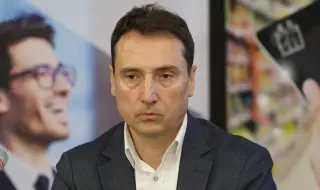
In a possible election today, 7 political forces would enter parliament, and two of the formations in the current National Assembly would be eliminated. This is shown by the data from a national survey, financed and implemented jointly by bTV and "Market LINKS", conducted among 1004 people over 18 in the country in the period 18 - 22 August 2025 using the methods of direct-personal interview and online survey. What does it show us… Dobromir Zhivkov from "Market LINKS" spoke to FACTI.
- Mr. Zhivkov, according to your latest survey, GERB-SDF continues to hold the leading position with 22.8% support. The difference with the second - PP-DB (13.3%), is about 9%. Is this a little or a lot?
- It is a lot from the point of view that such an electoral difference seems insurmountable for the second (PP-DB) and the third ("DPS-New Beginning"). Of course, if we accept the hypothesis that our political life will develop without significant shocks over the next 2-3 years. A little from the point of view of the positions that GERB had in the 2017 elections, when the party achieved almost 1/3 of the votes.
- "DPS - New Beginning" firmly enters the top three with 12.6%, approximately the same as the authentic MRF had over the years. Can we now talk about a united electorate of the party?
- I think that to a large extent the answer is - yes. Look, both the current Novo nachlaso and Mr. Dogan's MRF share the same model of political representation.
Both are characterized by the lack of a real value base, despite claims to have one.
Both are leadership-type formations, again with an imitation of democratic principles of internal party organization and management. Both are clientelistic in essence and their electoral support comes mainly from areas with a compact ethnic population, characterized by below-average and low social status.
These Bulgarian citizens, as has been proven, have long since come to terms with not expecting and not being able to demand much. They are often placed in deep dependence on local rulers.
- Ahmed Dogan stated that he would create a new party, and is following the legal steps. But what kind of electorate can he get back, what can he take from “DPS- New Beginning“?
- I do not see significant potential for a new project around Mr. Ahmed Dogan. Even in the messages of this initial press conference, obviously aimed more at politically active Bulgarians, the media and political parties, the party's positioning was stated as protecting the dignity of the people, and this means that we again have no indications of a clear value orientation. Even the ideas for a new liberal formation in the niche of the DPS around Mr. Dogan, which were publicly commented on some time ago in the space, were not mentioned. What prospects open up for a potential APS party, what will it actually offer to voters and how will it differ from “DPS-New Beginning“? Just because Mr. Ahmed Dogan is a victim of Mr. Delyan Peevski and the repressive state machine? The plot with the creation of the APS is reminiscent of those around the alternatives to the MRF, created by politicians isolated by Mr. Ahmed Dogan over the past 15 years, but this time Dogan himself is in their role.
- "Vazrazhdane" is fluctuating between third and fourth place. You are reporting 9.7%. Has the party lost its way in recent months. The topic of the euro, which was their favorite, has probably already passed, because it is clear that we will adopt the euro?
- The answer to this question will be given at the next parliamentary elections. For now, there are indications of a certain withdrawal of peripheral support, but let's not forget that “Vazrazhdane“ is successfully mobilizing anti-system sentiments among many Bulgarians. If you notice, “Vazrazhdane“ is constantly trying to impose its agenda on Bulgarian society, relying precisely on this resistance impulse of people who are extremely disappointed with Bulgarian institutions. But no matter how much they oppose the ruling status quo, when GERB is in it and we follow the votes on important topics in parliament, serious doubts remain about political mimicry by Kostadin Kostadinov's party.
- What new leitmotif can we expect from “Vazrazhdane“?
- I am far from thinking that their attack on the euro is over. There will probably be attempts at new radicalization and demonstrations in the fall, but unlikely with significant consequences. Their role in 2026 will be to use inflationary processes, expected tax increases and probable economic shocks for a new attack, which they will try to expand again to the topic of a referendum on remaining in the EU. The medium-range topics they usually use are related to the education system. This is their reserve area for deploying alarmist narratives and in which they conduct campaigns through which they maintain mobilization readiness among their sympathizers or divert public attention from their own political failures.
- The BSP is in fifth place at the 5% mark. Does the participation of the Socialists in the cabinet bring them more benefits or harm?
- For the moment, more harm is visible. The party continues to be marginalized. First of all, it crossed the heavy line of political polarization with GERB. Like PP-DB, the BSP (this also applies to ITN), as well as the patriotic and progressive formations of the last 10-15 years, will pay a heavy price for the partnership with Boyko Borisov, and now with Delyan Peevski. Secondly, it seems to have lost its way forward - there are no attempts to restore ties with the European left, which I believe condemns the BSP to a limited role in the eyes of left-wing voters. Another party in which ideology gives way to tactical and situational decisions without a clear vision for the future.
- In your opinion, Radostin Vassilev's MECH (4.2%) and Ivelin Mihaylov's "Velicie" (4.1%) should enter parliament. They are also on the border, but how do you view their presence in parliament? They are part of the opposition, but what can the opposition do?
- For all parties around the 4% barrier, it cannot be said with certainty whether they will be - or not - part of the next National Assembly.
Mech and “Velichie“ are the smaller variations of “Vazrazhdane”.
In general, they fall into a slightly broader segment of the aforementioned anti-system voters and the difference between them is in the specific attitude towards the political leader. Ideologically, they are almost indistinguishable. In this sense, and considering the quantitative ratio of forces in the 51st National Assembly, their role seems limited to attacking the majority with all possible parliamentary instruments, but without having a chance to offer a governing alternative.
- What does “There is such a people” not do – as part of the government, so that they are not in parliament according to the survey?
- Like the BSP, “There is such a people“ took a risk by entering the government and in a coalition with the model of government, for the destruction of which they demanded the trust of the Bulgarian citizens 4 years ago. In essence, their participation, and that of the BSP, legitimizes the core of the governing coalition, composed of GERB and “DPS-New Beginning“ or more specifically, Mr. Borisov and Mr. Peevski.
- And so we come to the high percentage - 16.8%, who have not decided who they would vote for. In this sense, is there room for a new party on the horizon?
- Although with so many formations in parliament, the apparently low voter turnout clearly shows that there is untapped potential. And it is not along the lines of the geopolitical opposition of Europe against Russia and our internal dimensions of this conflict, but will again follow our other internal division - the status quo against those who publicly fight for a restart of the state, especially in the part with corruption, the non-functioning justice system and the taken over institutions.
- Everyone is talking about a new potential party of President Rumen Radev, and he is silent. What potential does his possible project have?
- Such predictions are highly risky, because no matter how much they talk, there are no clear outlines. The first major challenge facing such a project would be clear positioning along the two major axes of division in society mentioned earlier.
The president has clearly stated his geopolitical position, while periodically trying to oppose the reborn model of governance of GERB, but now with the leading role of the MRF.
This is exactly where it seems to me that the great risk for the president's so-called future political project lies. Anti-corruption, the fight against the conquered state and maintaining the theses of the dictatorial regime in the Kremlin are incompatible values. Russia has reached the final stage of movement along this orbit and is already much closer to dictatorship. This openly raises questions about the democratic principles that the president stands for. And thus puts on the table the risk that his leading party will mobilize a significant number of citizens for about a year, two or even three, but then be doomed to political and electoral oblivion. A scenario that has played out before our eyes more than once in recent years