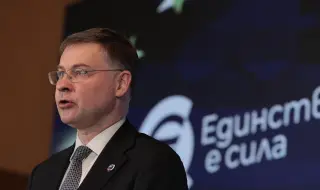
The euro is not just a currency, it is a powerful symbol of European integration. This was stated by European Commissioner for Economic and Monetary Affairs Valdis Dombrovskis during a joint press conference with Bulgarian Minister of Finance Temenuzhka Petkova.
Earlier today, the high-level conference "Bulgaria on the Threshold of the Eurozone" was held at the "Boyana" residence, in which Prime Minister Rosen Zhelyazkov, President of the European Central Bank (ECB) Christine Lagarde, and Governor of the Bulgarian National Bank (BNB) Dimitar Radev participated. The event was organized in connection with the upcoming accession of our country to the eurozone, BTA recalled.
Dombrovskis congratulated Bulgaria again on its accession to the eurozone, which he described as an incredible achievement. The path to the euro has strengthened Bulgarian institutions, and reforms have also been made, the European Commissioner pointed out. Joining the euro helps to encourage foreign investment, develops the economy, creates jobs, and will reduce interest rates, he also said. The benefits will be many, the European Commissioner assured.
We know that Bulgarians are worried about the price increase, Dombrovskis said. According to him, there is no reason for this. He gave the example of Croatia, where the impact on prices has been minimal. According to him, Latvia has also seen more stable and transparent prices and increased competitiveness after the adoption of the euro. Strengthening the business environment for Bulgaria will also be among the benefits listed by the European Commissioner.
The European Commissioner stressed that maintaining fiscal discipline must continue after joining the eurozone. Regarding Bulgaria's draft budget for 2026, Dombrovskis expressed satisfaction that the deficit will not exceed 3 percent of GDP. We are providing greater fiscal flexibility to member states, taking into account increased defense spending, he specified.
In response to a journalist's question about the European Commission's measures to reduce dependence on Chinese rare earth supply chains, Dombrovskis said that Brussels is maintaining a dialogue with the Chinese authorities to address short-term challenges. According to him, the goal should be diversification and expansion of suppliers for Europe, because China currently dominates the market.
Regarding the topic of disinformation, the European Commissioner emphasized that Russia is waging a hybrid war against the European Union and its member states. We must be clear on this issue and resolutely oppose these actions, he said. And he recalled that the European Commission adopted the "Defense of Democracy" package, in which it sets out how it will combat all these threats and actions by Russia.
Bulgaria joins the eurozone in a complex geopolitical context, in which the world is becoming increasingly fragmented and conflict-ridden. Therefore, it is even more important for the country to be part of a larger and stable geopolitical bloc, said European Commissioner for Economy and Productivity Valdis Dombrovskis during the high-level conference "Bulgaria on the Threshold of the Eurozone". The event is part of the national communication campaign for the introduction of the euro in Bulgaria from January 1, 2026.
Joining the eurozone does not only mean joining the monetary union and changing the coins and banknotes, but joining the heart of the European Union, he emphasized.
According to him, membership in the eurozone increases the resilience of countries, including by reducing the costs of public debt. He gave the example of the Baltic countries, for which, after the Russian invasion of Ukraine, the cost of credit has remained lower than in Poland and Hungary. This effect, the European Commissioner pointed out, is due to investors' confidence in the euro as a stabilizing factor.
Dombrovskis noted that in the countries joining the eurozone, debt costs are also decreasing, as investors perceive entry into the monetary union as a positive signal of stability and good financial management. In this way, the euro can further strengthen Bulgaria's resilience, the European Commissioner pointed out.
He reiterated the call for Bulgaria to continue to pursue a stable financial policy.