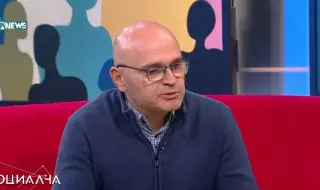
The volume of cyberattacks against banks has been increasing over the past year, but not the damage. Bulgarian institutions are working hard with European ones to counteract, but how protected are our accounts and money? The topic in the program “Social Network” on NOVA News was commented on by cybersecurity expert Spas Ivanov.
"Realistically, the picture looks like this - citizens bear the main responsibility for protecting their own accounts. At this stage, at least in Europe, and in Bulgaria in particular - there is no documented case in which a bank has been compromised to such an extent that citizens' money has been withdrawn. Because the bank as an infrastructure, as a banking system, has been “hacked” and from there funds were withdrawn", he explained.
According to him, the cases that are reported are usually from individual users, bank clients, who — either due to negligence, or due to the use of sophisticated techniques to steal their bank details — ultimately became victims and lost various amounts.
Ivanov explained that when designing the attack, the attacker decides whether to go after the “big fish“, that is, to withdraw a large amount from a bank account and then hide. Or he will choose another method, which is becoming increasingly popular — to withdraw small amounts from hundreds of thousands of accounts monthly, which do not arouse suspicion and attention from users.
"For example, amounts of 10, 15, 20 leva. Imagine that you have a statement with several hundred lines — this will not impress you at all. It is very likely that you will not even look at it, "he emphasized.
Ivanov also explained how hackers manage to get to the accounts. And this happens in many ways. Between the banks and the user there is usually some kind of electronic device - a smartphone, a computer, a tablet, or all of them together, depending on how active the user is. Usually, the security chain is broken there.
"If we talk about a smartphone, which is the most common reason, a surprisingly large number of people do not observe basic hygiene when using it, do not choose the brand and model, even though they use the device for banking, do not like to update it. The software updates that manufacturers provide are met with distrust. They also prohibit updating the applications themselves. They install all kinds of unverified applications - games, QR code scanners and other supposedly “useful” applications that very often serve as a springboard for cybercriminals to steal information," the cyber expert pointed out.
According to him, the moment the application is installed on an Android or iOS phone — it can steal your username and password. And if the application is well written, there have been dozens of reported cases around the world in which attackers managed to intercept the so-called one-time authorization code — the SMS messages with which we confirm transactions. "From then on, the bank will have no way to protect you, because it will have no way to determine whether the action was performed by you or not", the expert is categorical.
Claims against the bank, of course, can always be made. Every bank has "anti-fraud" systems — systems for detecting suspicious behavior." For example, if I make a transaction in Sofia, and two hours later there is a transaction from Aruba or Latin America, this is geographically impossible. In such cases, the systems raise “flags” and the transaction is declined or access to the account is temporarily suspended until the client contacts the bank,” Ivanov explained.