"The position of scientists from the Institute of Space Research and Technology is one of the leading in the world. For 55 years, our scientists have worked in almost all areas of space research. We are developing, modernizing, and increasingly working in a new way, through project financing. We can boast that in the last year alone we have established two collaborations with companies from China. One is with the Technological Engineering Center for Space Use, which is part of their Academy of Sciences.
The other Chinese organization with which we recently signed a memorandum is the Deep Space Research Laboratory, which is tasked with building the first Chinese base on the Moon. We are invited to participate in this process. We have many scientists who are developing equipment, as you know, the "Lulin" dosimeters are currently in use, located both on the International Space Station and in space itself. When specifying the task, we can develop the necessary product.
We also have a collaboration with the European Space Agency, with NASA, you know we are already members of the "Artemis" program, which is a continuation of the "Apollo" program. And why wouldn't we have an astronaut under this program? Until 4-5 years ago, it was difficult to attract young people to do science in Bulgaria, since they could go to Europe as students and then find their own careers there.
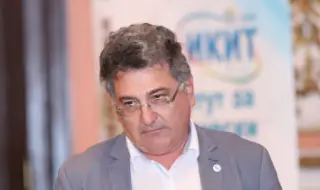
In recent years, there has been a trend of young scientists returning with a desire to work here, but there are still difficulties. On November 30, in the "Marin Drinov" hall - BAS, together with the Chinese embassy, the film "The Blue Planet Through the Porthole of the Station" will be presented. This is a film about the life of taikonauts, about what they observe from outside the station and what is seen with a view of our planet. On the BAS website, everyone can find detailed information about the screening, said Prof. Georgi Zhelev, director of the institute, on the air of the program "Afternoon for the Curious".
"My interest in the use of geographic information systems and satellite data, and my main idea was related to the use of these data in organic farming, and this actually brought me here to the institute. My dissertation was on the use of aerospace methods for monitoring biomass and yields of einkorn grown in organic farming conditions. I used two types of remote sensing data. One type was satellite data, and the other was drone data.
The goal is to predict the yield of this crop here on our planet, so that we can predict, for example, in March what yields farmers can expect if there are no catastrophic climate events. Such data can be used by various organizations in our country for management and prevention purposes. Working at the institute gives me many opportunities for various meetings, contacts and information, and the opportunity to work on various projects, the young scientist from the institute Milen Chanev told the broadcast of the program "Afternoon for the Curious".
Prof. Georgi Zhelev is the director of the Institute for Space Research and Technology at the Bulgarian Academy of Sciences. He graduated from the "Saint Ivan Rilski" Mining and Geology Institute. He has gone through the entire ladder of scientific growth – from assistant to professor. He is a member of the eighth general assembly of the Bulgarian Academy of Sciences, as well as of the Commission for International and European Cooperation. He has participated in 70 projects and has over 100 scientific publications. He was awarded for his services and contributions to space research on the occasion of the 40th anniversary of the Institute for Space Research and Technology.