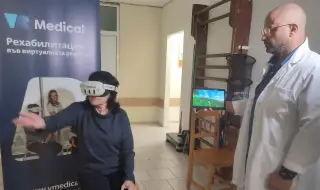
It looks like a computer game, but in fact it is a therapeutic system designed specifically for rehabilitation with real medical goals. The technology does not replace medical specialists, but works together with them and is already routinely applied in the work of the department. What else? Senior rehabilitator Kalin Boshev, who works in the rehabilitation and physiotherapy department at the Burgas University Hospital and is the only certified VR Medical trainer in Bulgaria, spoke in front of “FACTS”.
– Mr. Boshev, at the Burgas University Hospital you are already using virtual reality in rehabilitation. What does the VR Medical system actually represent?
– Simply put – this is a new way to make the patient move willingly. VR glasses are put on and a person falls in a different environment – it can be in a park, on the beach, among the stars or in an orchard. There he performs tasks – moves objects, keeps balance, “shops“, jumps over obstacles. It looks like a game, but in fact there is a medical program with specific goals behind everything. We set the exercises according to his condition and monitor in real time how he moves – how many degrees he raises his arm, what is the volume of movement, how fast he progresses.
– What kind of patients do you use it on?
– We use it on patients after surgeries – for example, shoulder or knee replacement, after fractures or injuries. It also works very well for people with neurological problems – multiple sclerosis, Parkinson's, hemiparesis after a stroke. We also work on balance, coordination, even on memory and concentration. It is also suitable for children, because the format is interesting and engaging.
– It looks like a computer game, but it's actually therapy. What's the specifics?
– The specifics are that while the patient "plays", he actually makes specific healing movements. For example, one of our patients, Nedka Valcheva, who had a shoulder replacement, shared something very revealing: “It's a bit tiring for the sick hand, but during the game you don't feel the pain. You feel like you're doing something pleasant. I can now raise my hand up.“
This is the huge difference - when a person doesn't constantly think about the pain, he relaxes and moves more boldly.
Immersion in the virtual environment reduces the fear of movement, and fear is often a bigger problem than the trauma itself.
– Can technology replace the specialist?
– No. And there is no way. It is a tool in the hands of the therapist. We choose the program, set the load, monitor safety. The system reports data, but the person who interprets it and makes decisions is the specialist. This is a joint work between technology and professional experience.
– The system allows working with two patients at the same time. How does this happen?
– Yes, we can work in parallel with two people, with an individual program for each. For example, one works on balance, and the other - on upper limb mobility. The software monitors the results separately. This allows us to be more efficient, without losing the personal approach to the patient.
– What are the reviews so far?
– People respond very positively. We often hear: “I didn't notice the time passing“ or “I want another round“. For a patient with motor deficit, this – to “hang out“ on the beach and fish – brings pleasure that standard rehabilitation can hardly provide. And when there is pleasure, there is motivation. And motivation is half the treatment.
– How has rehabilitation changed over the years?
– Before, we relied mainly on standard exercises – sometimes monotonous and painful. Today, technology allows us to make therapy more precise and more human. We can measure progress to the degree, change the load in real time and engage the patient emotionally. Rehabilitation has always been about movement. Now we simply add environment, meaning and experience to this movement. And the results are visible.