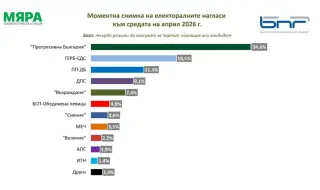
If the elections were held in the first half of April, the declarative support among those who stated that they would vote for a particular party, coalition or candidate would look as follows: “Progressive Bulgaria“ would win 34.6% of the votes, GERB-SDF – 18.5%, PPDB – 11.4%, DPS (“New Beginning“) – 9.1% and “Vazrazhdane“ – 7.4%. BSP-United Left would be on the very edge with 4%, not far from the edge are “Siyanie“ and MECH – with 3.6% and 3.5% respectively. “Velicie“ would have 2.2%, APS – 1.9%, and ITN would receive 1.4%.
The data are from a national representative survey by the sociological agency “Measure“ for the Bulgarian National Radio. The base has decided to vote for certain formations or candidates and this is a snapshot of electoral attitudes, with hundreds of thousands yet to decide who they will vote for.
With all the conditional nature of the electoral lists as well as the declarative nature of the respondents' answers, the potential turnout is 50.7%, i.e. higher compared to the respondents' intentions before the last elections and with a probability of being significantly over three million people. 1.7% of all those who said they would vote said they intended to vote with “I do not support anyone“.
5.6% of the entire sample are those who admit that they would vote for payment or other incentive in the upcoming elections. It seems that this percentage is expectedly highest among ghettoized groups. Of course, in such questions there are always hidden answers, so the real share is much higher. However, it is clear that now it seems low - perhaps because of the activation against vote buying. Perhaps that is why there are also some expectations for a fairer electoral process. As expected, 41.2% believe that these elections will be as fair as the previous ones, but among those who expect change, expectations for fairer elections prevail: 23.5%. 15.6% expect more unfair elections, and the rest are hesitant.
Among those who said they would vote, about two-thirds prefer to vote by machine. 19.1% prefer paper, and 13.2% have not decided. They cannot estimate the minimum share. Here, of course, the declarative nature of the answers must be taken into account, but overall the data confirm the previous observations of “Measure“.
Naturally, the greatest hopes are for a government of one political force - 33.4%, cooperation of two forces or some program format of government would like to see 14.9% and 12.5% respectively. A government with dynamic support is imagined by 9.2%, and more than three parties for a cabinet are imagined as a good option by 8.2%. Over a fifth are hesitant.
Nearly three-quarters do not expect an increase in their standard of living after the elections. The data also confirm the conclusions of the Social Tension Index published the day before - which indicates that prices are among the main concerns of Bulgarians.
The data are from „Myara“ for the Bulgarian National Radio. The survey is representative of the adult population in Bulgaria and was conducted between April 4 and 13, 2026, with interviews conducted „face-to-face“ with tablets among 1,002 adult Bulgarian citizens. The maximum stochastic error is ±3.1 at 50% shares. 1% of the entire sample (not of voters) equals nearly 54,000 people.