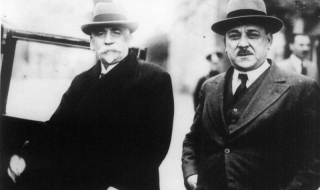
On May 15, 1954, in prison in Pazardzhik at the age of 79, one of the great bankers of post-liberation Bulgaria, politician, publicist and visionary Atanas Burov passed away.
The death certificate states that the cause of his death was chronic myocarditis and complete heart failure.
Atanas Burov was born in Gorna Oryahovitsa on January 30, 1875. He studied in his hometown and at the Aprilovska Gymnasium in Gabrovo. He graduated from the Sorbonne in Paris in 1903.
Atanas Burov's father - Dimitar Burov, founded the “Bulgarian Commercial Bank” in Ruse in 1895.
The bank and its related enterprises also formed the political force - the People's Party.
Dimitar Burov's work was to be continued by his two sons - Ivan and Atanas. The elder son, Ivan Burov, graduated from the Commercial Academy in Vienna, after which he worked at “Credit Lyonnais” in Marseille. After returning to Bulgaria, he took over the management of the Svishtov branch of the “Bulgarian Commercial Bank”. In 1909, Ivan Burov moved to Sofia and became a member of the Board of Directors of the “Bulgarian Commercial Bank”.
After his return from Paris, Atanas Burov also entered the banking business. He also became interested in politics and journalism. An active member of the People's Party, he became a member of parliament. He expressed his political views in the newspaper “Mir”.
Burov and the Balkan Wars
Burov was no exception and, like all his compatriots, went to the front during the wars for national unification. Shortly before the outbreak of the First Balkan War /1912/ he graduated from the Reserve Officers' School in an accelerated manner. At Chataldzha, a Turkish bullet lodged in his metal lighter in his upper pocket, but wounded him, for which he was awarded the Order of Bravery.
On June 1, 1913, Atanas Burov was appointed Minister of Trade and Industry in Stefan Danev's cabinet. A month-long participation in the government at a difficult time for the country gave him reason for reflections that changed his political views.
The sober assessment of the situation in the Balkans and Europe convinced Burov to firmly take the side of the Entente.
On October 6, 1917, Atanas Burov entered the cabinet of Alexander Stamboliyski as Minister of Trade and Industry, but from May 1, 1920, he was again in opposition.
In November 1920, the People's and People's Progressive Parties united in the United People's Progressive Party, of which Atanas Burov was elected secretary. With enormous energy, he worked to unite the forces standing to the right of the Bulgarian National Socialist Union and the Bulgarian Communist Party, attracting individuals from other political groups. This is how the People's Agreement was created. The basis of the Conspiracy was the “Bulgarian Commercial Bank”, as well as the great authority of Atanas Burov, who at that time was the Chairman of the Bulgarian Industrialists. The goal of the Conspiracy was to overthrow the farmers through parliamentary elections.
In 1923, two wings were formed - one for parliamentary democracy, led by Andrey Lyapchev and Atanas Burov,
and the other with a tendency towards conspiracy and violent methods in politics, led by Prof. Tsankov and Gen. Valkov.
In Lyapchev's government (1926 - 1931), Atanas Burov was Minister of Foreign Affairs. The complex internal and external situation required a lot of effort from the Foreign Minister, who, together with Finance Minister Vladimir Mollov, achieved a number of successes – the granting in 1928 of a loan called the “Stabilization” with the aim of stabilizing the national currency, developing transport and strengthening communication lines.
But the greatest difficulty was the settlement of the reparations problem.
The international situation was complicated, and the pressure from our interested neighbors gave rise to an unfavorable attitude of the great powers. After numerous visits and personal conversations, Burov and Mollov managed to extend the imposed moratorium on the “Reparations Debt” and significantly reduce the installments and the term of its repayment.
As Minister of Foreign Affairs, he was also Minister of Religions. On his initiative, the ephoria "Zograph" was created, which in a difficult moment for the Athos monasteries worked to support them and protect their interests.
After the coup of May 19, 1934, Atanas Burov wrote a series of articles in defense of parliamentarism, published in the newspaper "Mir".
Politician Atanas Burov also predicted the outbreak of World War II. He had the idea of creating a conservative anti-fascist front, for which he made numerous appeals, but the consolidation of right-wing political forces did not succeed. He agreed to join Konstantin Muraviev's government before September 9 with the idea of saving Bulgaria. The war declared by the USSR brought radical changes, the “Atanas Burov” Foundation recalls.
The old politician remained a supporter of parliamentarism and democracy.
Convicted by the People's Court, he was imprisoned, and in 1948 he was exiled to Dryanovo. In 1951 he was arrested again and sentenced by the People's Court to 20 years in prison. He died in Pazardzhik prison on May 15, 1954 from chronic myocarditis and complete heart failure at the age of 79 – years old.
Burov could have fled Bulgaria before September 9, 1944 and was invited by the head of the political police Nikola Geshev, the head of intelligence Andrei Pramatarov and the head of the criminal police, who had already set out to flee our country. They invited him to flee with them. Burov asked them “Where are you going, and they told him – We are going to the gendarmerie (Balkans) and we will pass through Greece or Turkey and in Western Europe we will form an emigrant government, and you will be the prime minister. Burov, however, said, “No, no. I was born in Bulgaria, whatever happens, I am staying here”.
Burov was not naive, but he thought that he would be protected because of his Anglophileism, he was courted by President Roosevelt's personal envoy to Bulgaria – Earl, as well as by the ambassadors of Great Britain and the United States.
The life and work of Atanas Burov are an integral part of the fate and history of Bulgaria. A prominent financier, politician and statesman of his time, he is still relevant today.