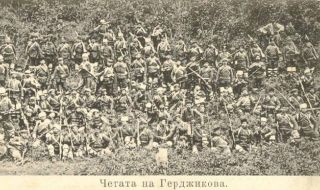
August 19, 1903. The Preobrazhensko Uprising breaks out in the Edirne region
The beginning of the insurgent actions in the Bitola district gives impetus to the revolutionary movement in Edirne Thrace as well. In accordance with the decision of the Thessaloniki Congress to declare a mass uprising in the Strandzha region, the Petrova Niva Congress was convened, which developed a plan of action and elected a general staff consisting of: Mihail Gerdzhikov, Lazar Madzharov and Stamat Ikonomov. On August 6 (August 19, old style, when it was Preobrazhensko) the fighting began, the Strandzha Republic was declared. Tsarevo, Ahtopol and other smaller settlements in Strandzha were liberated, and the Turkish units were pushed towards Malko Tarnovo and Lozengrad.
In the Bitola District, 150 battles took place between August 2 and October 23, in which 746 Chetniks died, in the Thessaloniki District - 38 battles and 109 Chetniks were killed, in the Skopje District - 15 battles and 93 were killed, and in the Edirne Revolutionary District 36 battles, 56 Chetniks and hundreds of civilians were killed. On September 12, 1903, the General Staff of the Bitola Revolutionary District issued a district letter to end the insurgent actions and self-disband the headquarters.
In Western Thrace, after the Rhodope Congress of the VMORO held there, the insurgent actions had a Chetnik character. In early August 1903, Peyu Shishmanov's detachment attacked the customs house in Karakulas. At the same time, Marin Cholakov's detachment placed dynamite on the railway line between Gyumurdzhina and Demirbeyli, but the explosion was defused by the authorities.
On August 18, Nedelcho Kilev's detachment, after the train had passed, blew up the Dedeagach-Gyumurdzhina railway line between the villages of Chobankoy and Kösemedjit, and traffic was stopped for a long time. Tanyu Nikolov's detachment and, separately, Kosta Nunkov's detachment mined the same and other railway lines, but the explosions failed. After the attack on August 18, 1903, the Chobankoy affair broke out.
The Turkish military undertook intensive searches in nearby Bulgarian villages, 33 people were arrested and sent to Edirne for a military court. Four were sentenced to death by hanging, and the rest to 15 years of exile. Many activists escaped by fleeing to Bulgaria.
The actions created strong tension among the Turkish authorities and additional military units were concentrated in all larger settlements. Thus, about 10,000 soldiers were pinned down in the Xanthi-Akhchelebi-Dedeagachko region, which could not be thrown against the other rebellious Bulgarian regions. This practically ended the insurgent actions.
The Strandzha Republic, also known as the Strandzha Commune, is the name of the government formed by the rebels of the Internal Macedonian-Adriatic Revolutionary Organization in the area between Malko Tarnovo and Tsarevo during the Ilinden-Preobrazhensko-Krastovdensko Uprising in the summer of 1903.
The commune existed for a little more than 20 days on part of the territory controlled by the rebels. Its functioning and organization were determined by the anarchist views of part of the leadership of the Edirne Revolutionary District, and especially of Mikhail Gerdzhikov.
The new social order, the essential feature of which was the lack of a supreme sultan or tsarist institution, was characterized and named differently by the participants in the uprising: Stoyan Stalev the Muscovite called it the “Free Republic”, Lefter Rusinov Mechev and Dimitar Hristov Dichev — “Short-term Republic”, and Hristo Silyanov — “Malko Tarnovo Commune”.
“On August 10, along the entire length of the Lozengrad Sanjak, the Turkish-Bulgarian border no longer existed” writes Silyanov. — Along this entire length, the principality bordered not with Turkey, but with the Turkish territory conquered by the rebels, with the newly founded state, which we named the “Malko Tarnovo Commune.”