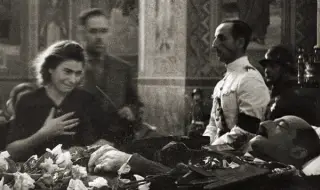
Tsar Boris III dies unexpectedly after a short illness at 4:22 p.m. on August 28, 1943. This happened shortly after returning from a visit to Hitler. According to the diary of the German attaché in Sofia at the time, Colonel von Schönebeck, the two German doctors who cared for the Tsar - Seitz and toxicologist Hans Eppinger - believed that the Tsar had died from the same poison that Dr. Eppinger had found two years earlier during the autopsy of Greek Prime Minister Ioannis Metaxas, a slow-acting poison that takes weeks to take effect and causes spots on the skin before death. Rumors of his death claim that he was poisoned on the orders of Hitler, who was known to have been furious after his last meeting with the Tsar and his refusal to hand over the Bulgarian Jews and send troops against the USSR.
Boris III ascended the throne on 3 October 1918, at the age of 24, having just returned from the Southern Front. As a young officer on the fronts of World War I, he had seen with his own eyes the mutinous soldiers after the Entente's breakthrough at Dobro Pole.
Tsar Boris III was the son of Tsar Ferdinand of Saxe-Coburg-Gotha and Princess Maria Louise. He was born on 30 January 1894 in Sofia. His godfather was Pope Leo XIII and the godchild was given the names Boris Clement Robert Maria Pius Stanislav and the title Prince Boris Tarnovsky. In 1896, he converted to the Orthodox faith with the Russian Emperor Nicholas II as his godfather.
The Crown Prince grew up under the tutelage of his despotic father, as his mother died when he was five years old. He received his secondary education in the Palace from teachers from the First Men's Gymnasium. He graduated from the Military School in Sofia.
Still very young, 24 years old, Boris III assumed the royal crown due to Ferdinand's abdication on October 3, 1918. The situation in the country was tense, the agricultural government of Alexander Stamboliyski (1919-1923) came to power, and on November 27, 1919, the humiliating Treaty of Neuilly was signed.
The coup of June 9, 1923 overthrew the agricultural leader Stamboliyski by military force and brutal murder. The cabinet of Alexander Tsankov was formed. In response to this, the September Uprising broke out, organized by the communists at the instigation of the Comintern. The country was shaken by terrorist actions, assassinations and confrontations between the leftist forces and the government of the coup plotters.
On April 14, 1925, anarchists attempted to assassinate Tsar Boris III in the Arabakonak Pass, but failed to kill him. On the same day, Gen. K. Georgiev, chairman of the Democratic Conspiracy, was shot in Sofia. Two days later, during the general's funeral in the church of ”St. Nedelya”, an assassination attempt was made and many people died. Tsar Boris was again saved due to his lateness for the ceremony.
The monarch called on the political forces to reconcile. On January 6, 1926, the new government of the Democratic Alliance was formed, headed by Andrey Lyapchev. In 1931, the People's Bloc (Democratic Party, BZNS ”Vrabcha”, Radical and National Liberal Parties) came to power. The inclusion of farmers in the government was an important step towards overcoming the political division.
The Tsar took up foreign policy. In 1933, he held three meetings with King Alexander of Yugoslavia, at which the two countries were brought closer together. He visited the European capitals of Brussels, Berlin and Paris. Gradually, Boris III established himself as a factor in international politics.
Bulgaria stabilized its internal and international situation after the coup of May 19, 1934, carried out by the Military League. The government of Kimon Georgiev was formed, which restored diplomatic relations with the USSR, liquidated the VMRO and other organizations.
On November 23, 1935, the government of Georgi Koseivanov was formed - the first non-party cabinet, which ruled until February 16, 1940. Radical reforms were carried out, which introduced the one-man regime of Tsar Boris III.
On the eve of World War II, the Bulgarian monarch closely monitored European interstate relations and events, condemned aggression and totalitarianism. In 1938, he refused to join Bulgaria to the Rome-Berlin axis. He sought rapprochement with London. Bulgaria did not join the Balkan Pact due to its national interests.
On September 1, 1939, Germany attacked Poland. World War II began. Bulgaria declared neutrality. At the initiative of Tsar Boris, surveys were conducted in Berlin and Moscow regarding the return of Southern Dobrudja.
In October 1939, the 24th National Socialist Council was dissolved. In February 1940, the government of Georgi Kyoseivanov was replaced by the government of Bogdan Filov. Boris III continued to claim that Bulgaria would maintain ”unconditional neutrality”.
But events took a different turn. On September 7, 1940, in Craiova, under pressure from Germany, Romania signed the treaty for the return of Southern Dobrudja to Bulgaria. On March 1, 1941, in Vienna, Prime Minister Bogdan Filov signed the protocol for Bulgaria's accession to the Tripartite Pact.
Tsar Boris III failed to maintain the neutrality he so desired. On December 13, 1941, Bulgaria declared a ”symbolic war” on England and the USA. As early as April 1941, British and Yugoslav aircraft bombed Sofia and Kyustendil. The air attacks became most intense and destructive in 1943.
Despite his ability to maneuver and wait, Tsar Boris III failed to avoid war. With the support of the Germans, Macedonia and part of the Aegean Sea were annexed. After the dissolution of the 24th National Assembly and the removal of Georgi Kyoseivanov from the post of Prime Minister, Boris III bore all political responsibility. His achievements were the non-participation of Bulgarian troops on the Eastern Front and the opposition to German policy towards the Jews.
The unbearable burden of political responsibilities led to the early and unexpected death of Tsar Boris III.