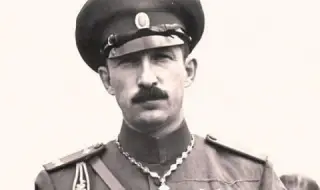
Boris III ascends the Bulgarian throne on October 3, 1918.
On this day, Tsar Ferdinand I signs a manifesto in which he abdicates the throne in favor of his son, according to information from the “Reference” department of BTA.
When concluding the Armistice of Thessaloniki on September 29, 1918, with which Bulgaria capitulated and withdrew from World War I, the Entente set a mandatory condition that Ferdinand renounce the Bulgarian throne and leave Bulgaria.
Ferdinand Saxe-Coburg-Gotha was a German prince, Bulgarian prince (June 25, 1887-September 22, 1908) and Tsar (September 22, 1908-October 3, 1918) of Bulgaria. Born on February 26, 1861. On June 25, 1887, the III Grand National Assembly elected him Prince of Bulgaria. On September 22, 1908, after the proclamation of Bulgaria's independence, Ferdinand I was proclaimed Tsar of the Bulgarians. He died on 10 September 1948 in Germany.
Boris III, whose full name was Boris Clement Robert Louis Stanislas Xavier, Prince of Tarnów, Duke of Saxony and Prince of Saxe-Coburg and Gotha, ruled Bulgaria from 3 October 1918 until his death on 28 August 1943.
Born on 30 January 1894. Son of Tsar Ferdinand and Princess Maria Louise. During his reign, Boris III strengthened the role of the monarchical government. He joined Bulgaria in the Tripartite Pact (1 March 1941), but did not send troops to the Eastern Front. Tsar Boris III was three times a knight of the French Legion of Honour, a knight of the English Royal Victorian Order, of the Order of Leopold (Belgium), of the Household Knights of the Order of St. Hubertus" (Bavaria), the orders of the "Red Eagle" (Prussia), "St. Andrew the First-Called", "St. Alexander Nevsky" and "St. Anna" (Russia), orders of Romania, Italy (Parma and Sicily), Poland, etc.
He died under unclear circumstances. He was buried on September 5, 1943 in the monastery church of the Rila Monastery. On April 24, 1946, the mortal remains of Boris III were removed from the holy monastery and reburied in the chapel of the "Vrana" palace. In 1946, the chapel was destroyed. On October 18, 1991, during excavations in the "Vrana" park, a jar with an inscription was discovered that it contained the heart of Tsar Boris III. It was handed over for safekeeping in the vault of the Bulgarian National Bank. On August 23, 1993, the vial was removed and reburied in the restored grave in the Rila Monastery.
Here is how BTA covers the first steps of the new monarch in the days after his accession to the throne:
Sofia, October 7, 1918. On the 4th of that day (September 4, 1918 - editor's note), after the oath-taking ceremony in the military club by the officers of the Sofia garrison, His Majesty the Tsar delivered the following speech:
“Gentlemen,
Taking an act of the promise that you have just made before the Almighty, I thank you.
Witness of all that the army has accomplished during the long years of struggle against our numerous enemies, I deeply believe that despite the difficult moments that we are experiencing, with your steadfastness (…) and devotion to duty, we will together succeed in healing the wounds that criminals inflicted on our brave army.
Yes, I am convinced that you will do everything for the speedy restoration of order and discipline in all units, and on the other hand, rich in the freshest lessons of the war, you will soon be able to direct the preparation and training of the army so that it firmly stands at that height from which the integrity and security of the Fatherland can be guaranteed.
I count on you, just as you served His Majesty the Tsar, My Beloved August Father, honestly and faithfully, to continue to support Me.
Long live Bulgaria! Long live the Bulgarian Army! Hurray!”
The Minister of War, General Savov, responded to this speech with emotional words.
***
Sofia, October 7, 1918. Speech delivered by the commandant of the Sofia Fortress, Major General Protogerov, on 4.X.1918 after noon at the camp during the oath of allegiance to His Majesty Tsar Boris III by the troops of the Sofia garrison.
“Soldiers,
In the three-year war, the Bulgarian armed people spent days of joy and sorrow, days of greatness and sadness; today, when we should be happy that peace is coming, that streams of Bulgarian blood have ceased to flow, the Bulgarian people are exposed to new and most severe trials. In difficult times for our people, we must today take an oath before our new Tsar, the Tsar of the Bulgarians Boris. We, soldiers and officers, must unite around him in order to save the fatherland from disaster. Let us remember well that the existence of Bulgaria, the existence of our Hearth, depends on us, on every Bulgarian, on every soldier; let us remember well that our fatherland is going through very difficult moments, which can be overcome only if there is unity among all Bulgarians, if all the national energy is used to overcome the great dangers, and not to weaken it in internal strife. Only in this way will we be able to save our fatherland.
That is why let us turn our thoughts to God, so that He may support us and give our word that our hearts will beat as one heart, fused with that of our Tsar, so that under his scepter we may save Bulgaria. As we promise this, let us swear allegiance to the new beloved Tsar and let us all shout: LONG LIVE THE Tsar of the Bulgarians, Boris! Hurrah!”
***
Sofia, October 7, 1918. On Saturday, the 5th of October at 5:30 p.m. (October 5, after noon - ed.), His Majesty Tsar Boris received a report from Prime Minister A. Malinov. At 7:30 a.m., all the other ministers who had been invited by the Tsar to an intimate meeting and held for dinner also arrived at the palace. The young Tsar was very cheerful and cheerful, and with his characteristic friendliness and ease he captivated his first guests, with whom he talked at length on various issues. Among other things, the Tsar addressed the ministers with the following words:
“Gentlemen,
I thank you for the great pleasure you gave me by responding to my invitation, because I was very keen that you, gentlemen ministers, be the first guests in my house. In difficult times, in the midst of events of fateful importance, I take on a difficult task that the Fatherland imposes on me. But I am not afraid of it, because I believe in the future of our people. As I said yesterday to him: “The star of Bulgaria has not set, it will not set.”
Born and raised among the democratic Bulgarian people, I have grown close to it; its pains and longings and its few joys are close to my heart. I saw this hardworking people in sorrows and joys, in peaceful, gracious labor, creating their well-being and, for years, a fighter to the point of self-denial for the protection of the homeland and the realization of the national ideal.
Sacredly respecting the laws and order in the country, and above all the basic law - the Constitution, let us all devote ourselves entirely to serving the people and forge a brighter future for them, worthy of their efforts and the virtues that they conceal within themselves. And I hope that with God's help, we will overcome the difficulties, we will be able to swim to the saving shore and save the Fatherland from the abyss that looms over it. All my plans will be in this spirit and all my efforts will be directed in this direction.
In the fulfillment of my task, I will be guided by the will of the people, I will rely on their devotion and I will be guided by your enlightened and patriotic advice, which, I am convinced, will never be denied me. The Fatherland is in danger, but it will not perish. Be, Gentlemen, my most sincere advisers; I wish to know all the desires and all the pains of the people, because only in this way can we be useful to them. Let us all work quickly and diligently, with complete mutual trust in each other, because we all pursue the same goal - the good of the people and the greatness of Bulgaria.”
***
Interesting facts can be found in the BTA bulletin and in the confidential scrolls about the abdication of Tsar Ferdinand:
Vienna, October 5, 1918. The reviews of the local press about Tsar Ferdinand I are very unfair. They do not deny his great statesmanship, but they reproach him for putting his allies in a critical position by hatching a plan behind their backs.
The “Arbeiter Zeitung” expresses itself most sharply, writing: It is true that Tsar Ferdinand made great efforts for the elevation of Bulgaria, but the bad quality of his character is the reason why the efforts of the Bulgarian people remained fruitless. Cunning and intelligence alone are not enough for lasting success. Tsar Ferdinand, with his duplicity, destroyed everything that he himself was afraid to do. He lacked valor and firmness to the end, because the fear for his own person was greater than the care for the state.
About Tsar Boris, the newspapers report only biographical notes and short messages from Sofia about the enthusiasm with which he was greeted by the entire Bulgarian people. Some newspapers add that the Bulgarians feel him as a Bulgarian, not as a foreigner. They refrain from other criticism.
***
Bucharest, October 8, 1918. “Stiagul” transmits in summary revelations, based on reports from Moscow, about the existence of a secret correspondence between the Entente and Bulgaria during the war. According to this correspondence, which spanned four thick volumes, the strange role played by the current Bulgarian Prime Minister himself (Alexander Malinov - ed. note), by his associates, and by Tsar Ferdinand and his confidant Rizov came to light. (…)
***
Bucharest, October 8, 1918. In "Tegliche Rundschau" of October 5, 1918, on the occasion of the abdication of Tsar Ferdinand, E.S. wrote: The role that Tsar Ferdinand played in the last days and weeks is questionable, and his honor is no longer impeccable (irreproachable - ed. note). The documents printed by the Bolshevik “Izvestia” show that last year Bulgaria was seriously concerned with the issue of a separate peace. Bulgarian representatives abroad tried to enter into relations with the Entente, and Tsar Ferdinand himself studied the proposals of the Entente states, struggling to retain the throne in case a separate peace was reached. However, the Entente's proposals forced him to abandon a separate peace. He had also made moves before Wilson (Woodrow Wilson - US President during the First World War - ed. note). That is why it is easy to explain why the Bulgarians have only just concluded a separate peace, and at the moment when Tsar Ferdinand is letting go of the reins of government. It is not established to what extent he relied on understanding. The ruler, who would have been unconditionally loyal, would not have hesitated to warn in Vienna and Berlin of the impending dangers. Ferdinand did not do this; he even seems to have deceived our Sofia representations about the state of affairs; with his assurances of allied loyalty, made in Vienna and Berlin, he brought even more confusion. Here we are also guilty. As in Romania, we were very trusting, and we believed everything we were told. Our entire military and peace policy was not designed to inspire faith in a people who only looked after their own interests. The Bucharest Peace was often defended by saying that the Bulgarians should not have been given a leading role in the Balkans. In Bulgaria, however, the belief had already been widespread that we would secure for her a leading role in the Balkans. The policy of denial preached by the socialists, the lazy military policy, the Serbian and Montenegrin questions, the insufficient will to fight against England, gave rise in Bulgaria to the thought that our position after the war would not be strong enough to secure her gains in the Balkans. (…)
The lesson of the separation of Bulgaria is that in the future our foreign policy should not be guided by German concepts of honor and that the manifestation of power, not reconciliation and love, determines the destinies of a state that wants to prosper. Now, we have rejected this teaching and believe in the power of reconciliation. When it is too late, then we will be convinced of the opposite.
***
Geneva, October 11, 1918. The newspaper "Noe Berner Zeitung", speaking of the abdication of Tsar Ferdinand, finds that it is the result of his unsuccessful policy of Bulgarian hegemony in the Balkans. - Peace can be established in the Balkans only with a federation of the Balkan states. Tsar Boris must abandon the idea of hegemony and live with that of rapprochement of the peoples.
***
Stockholm, October 15, 1918. In "Stockholms Tidningen" Alfred Jensen wrote an article entitled: "Improvement in the Balkans?”, in which he said: Indeed, one of the reasons for the separation of Bulgaria was the dissatisfaction with the Peace of Bucharest, which resolved the Dobrudja question in a way unpleasant for Bulgaria. But a more important reason than this rather accidental occasion is the despondency caused by the isolation of the Bulgarians in the midst of the Slavic world. The abdication of Tsar Ferdinand, despite his eternal services to Bulgaria, must be considered a relief of the Balkan situation. Now the idea of a Balkan union without Greek and Romanian cooperation must be taken up again. (…)