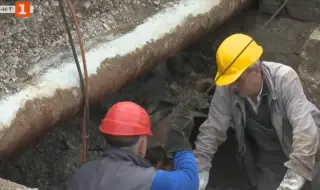
The most compromised pipelines in Pleven have already been discovered, announced to BNT Prof. Gancho Dimitrov, Chairman of the Supervisory Board of the Water and Sewerage Holding and member of the crisis headquarters in the city.
He added that three immediate actions have been taken to overcome the crisis in Pleven. They provide for the urgent replacement of the most compromised water pipes in the city, zoning of the network and regulation of the imposition. According to Assoc. Prof. Dimitrov from UACEG, some of the medium-term measures such as drilling and water from the "Sopot" dam will not give a quick result.
The neighborhoods with the greatest losses in Pleven are now clear, announced Prof. Gancho Dimitrov.
"These are "Druzhba" 1 and "Druzhba" 2. These are 2 areas in which there are significant water losses and we should start there - replacing the water supply network. Selective replacement of the most worn pipe sections, which are depreciated with frequent accidents, can be applied. The second thing that needs to be done is zoning the water supply network. That is, maintaining optimal pressures through zoning. And the third - this is pressure regulation and reducing physical losses. Not only the losses, but also the frequency of accidents", said Prof. Gancho Dimitrov.
Before that, however, the city's water and sanitation company must select the network according to its load.
"There must be zoning of the water supply network, measurement of night costs, measurement of daily costs and measurement of pressure in order to accurately determine the physical losses", commented Prof. Gancho Dimitrov.
According to the lecturer from the University of Applied Sciences and Arts, Associate Professor Bozhkov, bringing water from the Danube to Pleven will not work.
"One of the options is to use wells from the terrace of the Danube River, but unfortunately we do not have such a water supply system that would connect these wells, the water from these wells and bring it to the city of Pleven. Such a water supply system must be built, including a treatment plant, which requires time. There is no way it can be done," said Assoc. Prof. Dr. Eng. Ventsi Bozhkov, a lecturer at UACEG.
The intention to supply from the "Sopot" dam is also questionable.
"The water that is in the "Sopot" dam can reach Pleven along a route, about a hundred kilometers long on a surface road, flowing along river valleys, a main irrigation canal, to reach the "Gorni Dabnik" dam, then Dolni Dabnik, and from there again. Since there is no working pipeline, this water absolutely must be purified, because no matter how clean it is, it has already become polluted on its way," said Assoc. Prof. Dr. eng. Ventsi Bozhkov.
The drillings, on which great hopes are placed, do not solve the problem.
"Again, we do not know how much this water will come out, what it will come out of, it may not be able to be directly supplied to the citizens of Pleven. This water absolutely must be purified", commented Assoc. Prof. Dr. Eng. Ventsi Bozhkov.
The option to build a "Cherni Osam" dam remains on the agenda as an opportunity to permanently solve the water problem of Pleven, Troyan and Lovech, but because of Natura 2000, its construction may be delayed due to environmental restrictions.