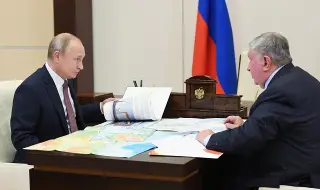
Russian President Vladimir Putin has asked leading Russian businessmen to provide financing for the Russian government. This indicates that the Kremlin may be in desperate need of economic aid and may be setting conditions for nationalizing assets to support the war effort. The independent Russian newspaper The Bell reported, citing multiple sources familiar with the conversation, that Putin held a closed-door meeting with leading Russian businessmen on March 26, at which he urged businessmen to contribute funds to the Russian federal budget.
This is according to the "Institute for the Study of War" (ISW).
A source told The Bell that the idea came from the head of Russian state oil company "Rosneft" Igor Sechin, who reportedly made the proposal and a proposal to issue military bonds as a fundraising mechanism for Putin on March 25.
The Bell reported that Russia's Federation Council senator Suleiman Kerimov immediately pledged 100 billion rubles (about $1.22 billion) to Putin and that another unnamed businessman promised additional support, but did not disclose the amount.
Kremlin spokesman Dmitry Peskov confirmed that Putin had met with Russian businessmen but denied asking for money from the businessmen, that the money was for the war effort, and that the idea came from Sechin.
Peskov claimed that one of the participants discussed the need to donate "a very large sum of money" of the Russian state, but stressed that it was a personal decision.
This threatens to break a promise he made to Russian oligarchs not to nationalize their assets soon after taking power. Putin met with leading Russian businessmen in July 2000 and promised to uphold the 1990s privatization of assets that previously belonged to the Soviet Union, in exchange for the businessmen staying out of Russian politics and swearing allegiance to him.
On March 27, Peskov said that one of the participants in the March 26 meeting had noted that most of those present had started their businesses in the 1990s and were connected to the Russian state "in one way or another" at that time, so many of the participants "consider it their duty" to make financial contributions to the Russian state.
Putin has repeatedly hinted that the Kremlin is against nationalization of property, but has gradually accelerated it during the war.
Peskov’s reference to the privatization of industrial assets in Russia in the 1990s and the suggestion that businessmen should consider financing the Russian state as their "debt" may be intended to create a model of expected behavior for oligarchs amid Russia’s increasing censorship efforts. The Kremlin’s crackdown on Telegram and other internet censorship efforts could help neutralize businessmen who might try to oppose the Kremlin’s nationalization efforts by weaponizing the information space.
Ukraine and Saudi Arabia signed a defense cooperation agreement on March 27. Ukraine's presidential office said Ukraine would help Saudi Arabia with air defense under the agreement, which also outlines the basis for further contacts and includes technological cooperation and investment.
Ukrainian President Volodymyr Zelensky signed the agreement ahead of further talks with Saudi Crown Prince Mohammed bin Salman al-Saud. Zelensky said such cooperation could be mutually beneficial as Saudi Arabia has "something Ukraine is interested in".
On March 27, Latvia warned that Russia had launched a campaign of cognitive warfare, falsely accusing the Baltic states of allowing Ukraine to launch strikes against Russia from their territories. The Latvian Ministry of Defense (MOD) said on March 27 that Russia is waging a large-scale information war against Latvia, Lithuania, and Estonia, falsely claiming that the Baltic states are allowing Ukrainian forces to use their territory for strikes against Russia.
The Latvian MoD is likely responding to claims that authorities have found downed Ukrainian drones in Latvia and Estonia that were likely diverted by Russian electronic warfare.
The Latvian MoD stressed that the Baltic states are not involved in the planning and execution of Ukrainian strikes against Russia.