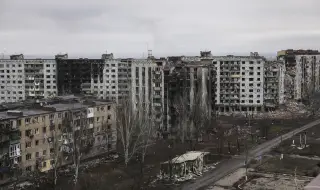
Russia announced that it had captured the first major city in Ukraine since the beginning of this year. It also ended the emerging trend of losing more Ukrainian territory than it has captured per month. The war of attrition continues, however, with the two sides in the conflict constantly exchanging deadly blows, as a result of which Russia, one of the world's largest oil producers, is gripped by a fuel shortage crisis, BTA reports.
Russian President Vladimir Putin visited one of the auxiliary command posts of the country's armed forces yesterday, where Chief of the General Staff Valery Gerasimov reported to him that Konstantinovka had been captured, TASS reported.
"The city was turned into, as the Kiev regime believed, an impenetrable fortified area, but thanks to the heroism of our troops, it has now been completely liberated," added Dmitry Peskov, Putin's press secretary, after a meeting with the Russian head of state and the high military command.
The news of the capture of Konstantinovka has not been independently verified. There has been no comment from the Ukrainian side so far.
However, the General Staff of the Armed Forces of Ukraine (AFU) said in its evening briefing, quoted by Ukrinform, that according to operational data as of 10:00 p.m. (Bulgarian time) yesterday, a total of 225 battles took place.
The Russian army tried to attack most actively in the Slavyansk and specifically the Konstantinovka direction in the Donetsk region, the text published on Facebook notes. In the area of Konstantinovka, in particular, 24 Russian attacks were reportedly repelled.
According to geolocation footage published the day before yesterday on the website of the American think tank Institute for the Study of War, the Russian army claims to have practically completely surrounded the city center, but the Ukrainian Armed Forces maintain a presence there.
The battle for Konstantinovka, which before the outbreak of the war four years and four months ago had a population of approximately 78,000 people, has been going on since the end of last year, when Russian soldiers began to penetrate into the city. Konstantinovka is now Russia's main target on the front, which stretches for more than 1,000 kilometers, notes Agence France-Presse.
It is one of the last major cities in the Donetsk region that remains under Ukrainian control. Russia has seized over 80% of this eastern Ukrainian region.
Peskov also said that Russian troops fully control the neighboring Luhansk region - a claim that a representative of Moscow has made for the second time.
Together with Donetsk region, it forms the Donbas industrial region, which Russia has declared annexed, along with the so-called Novorossiya, which includes Zaporizhia and Kherson regions.
At a meeting at the command post he visited, Putin noted that the pace of the Russian army's advance was increasing along the entire front line.
The Russian army has the initiative on the entire front, his press secretary assured.
A number of other successes were reported at the meeting in addition to the alleged capture of Konstantinovka: that Russian forces were respectively 7 kilometers from Slavyansk, 9 kilometers from Zaporizhia and 10 kilometers from Sumy.
At the pace of the Russian offensive since the beginning of the war, overcoming even such distances would take months, if not years, and the price would be the lives of thousands of Russian soldiers, commented another American think tank - the Center for Strategic and International Studies.
In fact, Konstantinovka was one of the cities in the so-called belt of fortresses in the Donetsk region. The Russian army is only a few kilometers from Druzhkovka, Kramatorsk and Slavyansk, but unless there is some dramatic change, the capture of each of these cities would be a slow and complicated operation.
The meeting, widely reported by Russian state media, took place at a command post in the Northern Military District, northern Russia, i.e. far from the front in Ukraine. It took place after weeks of strikes on Russian energy infrastructure that led to fuel shortages in the country. Early Thursday morning, it carried out a massive airstrike on the Ukrainian capital, Kiev, in which local authorities said at least 30 people were killed.
These developments seem to reflect the Russian leadership's desire to demonstrate that the so-called special military operation (SVO) in Ukraine is going according to plan - at a time when Ukrainian drone strikes deep into Russian territory are making the conflict increasingly visible to Russian society.
And it largely preferred not to notice the war, Le Monde reported last month. The French daily noted that now that more and more Russians are directly affected by the Ukrainian strikes in the country, it is entirely possible that public discontent and opposition to the SVO will intensify.
In addition to the carefully orchestrated meeting, the Kremlin's position was also strengthened by a piece of good news for it. After Russia lost more territory in Ukraine in April and May than it gained, according to the Institute for the Study of War, the Washington-based think tank now reports on its website that the Russian army has put an end to the negative trend, having captured a net 30 square kilometers of Ukrainian territory in June.
However, the bloody conflict has been going on for five years, with no end in sight. And it seems to be of key importance who will gain the upper hand in military development and innovation.
Commenting late last month on Ukraine's campaign of medium- and long-range drone strikes, Putin said unequivocally: "The first task is to quickly and significantly increase the production of those air defense systems that are most needed."
Zelensky, for his part, expressed confidence yesterday, quoted by DPA, that Ukraine could overtake Russia in the long term in the production of high-tech weapons.
As for the prospects for substantive peace talks, the Russian president seemed to show once again yesterday that they remain an illusion. Amidst attempts by European countries to mediate to end the war, Putin commented that "the so-called European peacekeepers" are striving not for peace, but for the continuation of the war "to the last Ukrainian".
In fact, the Ukrainian president proposed last month in an open letter to his Russian counterpart to meet, but was refused, Reuters notes.
So, Russia and Ukraine remain in a dead grip of exhaustion for the fifth year. Given the incompatible positions of the two sides, it still seems unlikely that the conflict will be resolved through negotiations.
Meanwhile, the human cost of the war is becoming higher, with the number of dead, not only soldiers, but also civilians, growing with each passing day.