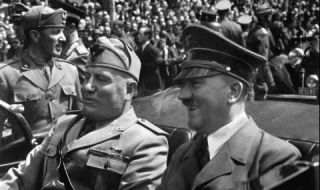
On April 28, 1945, Benito Mussolini and his mistress Clara Petacci were executed by members of the Italian resistance. The entire country was engulfed in a powerful anti-fascist uprising, and Anglo-American troops were advancing from the south.
The uprising was led by the National Committee for the Liberation of Northern Italy (CNOSI), which had been established more than a year earlier, and which included five parties - from the communists to the Christian Democrats. The command of the partisan forces with over 200,000 fighters was entrusted to a partisan headquarters headed by General Raffaele Cadorna.
By April 25, the rebels had established control over the large industrial centers of Turin, Milan and Genoa and many other settlements.
The Duce had been in Milan since April 14. Feeling betrayed and abandoned by his German patrons, he desperately sought a way to escape. His emissary established contact with some members of the CNOSI. Committee member Sandro Pertini, future president of Italy, was categorical: The Duce must admit defeat, surrender unconditionally and await the verdict given to him by the people. Attempts, again through an intermediary, to seek asylum in Switzerland were also fruitless. The authorities in Bern made it clear that they did not object to the arrival of women and children, but under no circumstances could they accept fascist leaders.
Finding himself in an impasse, on the afternoon of April 25, Mussolini left Milan and headed north with his entourage. The next day, he was joined by the artist Clara Petacci, who had been his lover since 1932. After some mishaps, the two, along with other associates of the dictator, joined a German military column that was moving along a steep Alpine road. No one knew where they would end up, and that they had entered an area controlled by the 52nd partisan assault brigade "Luigi Clerici". Its commander was Count Pierluigi Bellini delle Stella.
On the morning of April 27, the column was stopped by a partisan post near the village of Musso. The partisans were few, so they agreed to let the Germans through (they were disarmed and captured near the border), detaining the Italian fascists traveling with them. While inspecting one of the trucks, the partisan Giuseppe Negri noticed a figure in a German uniform dozing in the corner.
When asked who this man was, German soldiers answered: "A drunkard". Negri lifted the cape to examine the "drunkard's" face, and immediately recognized Mussolini. The Duce, his mistress, and other fascists were taken out of the cars. The arrested were taken to the nearby mountain town of Dongo, where the 52nd Brigade was headquartered. For safety, Mussolini and Petacci were taken to the small village of Bonzanigo. There they were placed in the home of a trusted peasant family, personally known to the brigade's political commissar Michele Moretti. Two partisans were left to guard them.
At 4:10 p.m. on April 28, 1945, the Duce was executed. The bodies of the murdered were taken to the "Loretto" square and hung upside down on the scaffolding of a local gas station. The symbolism is tragic - in the same place on August 10, 1944, the fascists left the bodies of 15 patriots, shot as hostages, as a lesson.