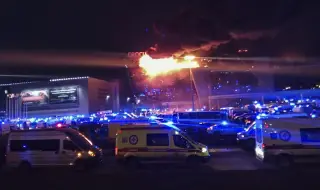
The perpetrators of the terrorist attack on the Crocus City Hall concert hall in Krasnogorsk, Moscow Region, acted not so much out of religious fanaticism, but rather for money under the influence of the organizers. This is shown by materials from the criminal case available to TASS.
This conclusion was reached by experts who reviewed the statements of the terrorists and the videos they made.
"The actions of Fariduni Sh., Mirzoev D. B., Fayzov M. Z. and Rachabalizoda S. M. do not show signs of true religious fanaticism, which are inherent in radical Islamists. The terrorists apparently took measures for self-preservation, acting in order to receive the promised reward. The terrorist act was committed not for ideological and religious reasons, but under the influence of manipulation by the "clients" who used them as "biological drones," the materials say.
Experts have concluded that the perpetrators were "programmed" to carry out a terrorist attack, the purpose of which was to cause the greatest harm to the civilian population, and not to spread radical religious ideas. Religion, experts believe, in this case was used only as a lever to manipulate the minds of the terrorists.
One of the perpetrators of the terrorist attack, Saidakram Rachabalizoda, was expelled from Russia in 2018. and was banned from entering the country until September 2023.
During this period, Rachabalizoda, after watching videos on Telegram and YouTube, began to share the views of radical Islam, and also subscribed to the Telegram channel of the structural unit of the terrorist organization "Islamic State" (DAESH) - Vilayet Khorasan. There, the accused wrote about his desire to join the terrorist organization, after which he was contacted by a curator who introduced himself as Sayfullo. He reported the need to fly to Turkey, from where he was supposed to be sent to Afghanistan, where he would become a member of Vilayet Khorasan.
We recall that in early July it became clear that training to carry out the terrorist attack had been conducted since June 2023 on the territory of Turkey and Afghanistan.
The terrorist attack in "Crocus" was carried out on March 22, 2024.
According to updated data from the Investigative Committee, 149 people were killed, one person is missing, and 609 citizens were injured to varying degrees.
The total damage from the attack amounted to about 6 billion rubles.
After the attack, four of the perpetrators tried to flee to Ukraine, but were detained in the Bryansk region and taken to Moscow. Some of their accomplices also received instructions from the organizers to leave Russia, but were detained while trying to cross the border.
The criminal case against the accused has been sent to the prosecutor's office for subsequent transfer to the court. The defendants are 19: Shamsiddin Fariduni, Dalerjon Mirzoev, Mukhamedsobir Faizov, Saidokram Murodali Rachabalizoda, Shahromjon Gadoev, Zubaydulo Ismoilov, Huseyn Khamidov, Muhammad Zoir Sharipzoda, Yakubjon Davlatkhon Yusufzoda, Nazrimad Lutfuloy, Jumahon Kurbonov, Huseyn Medov, Dzhabrail Aushev, Alisher Kasimov, Umedjon and Mustakim Solievi, Isroil Islomov, Dilovar and Aminchon Islomov (all included in the list of terrorists in the Russian Federation).
The investigation against two organizers and four members of the terrorist organization continues.
Shortly after the attack itself, "Islamic State" claimed responsibility for the attack - a claim that the United States publicly supported. American officials indicated that they had warned Russia that month about the upcoming attack with intelligence. Moscow also received a warning from Iran.
At the end of May, the director of the Federal Security Service (FSB), Alexander Bortnikov, said that the attack on the concert hall was organized by a branch of the "Islamic State", but that Ukrainian intelligence was to blame for it.
Ukraine, as well as representatives of Western countries, called Moscow's claims "having nothing to do with reality".