


The world of electric hypercars has just received a new, terrifying contender for the throne, which promises to rewrite the laws of physics. After nearly five years of intensive development, German startup Elektron Motors has officially taken the wraps off its technological monster - the Elektron Quasar. The brainchild of the brand's ambitious founder, Argaman Araboul, not only enters the deep waters of the exotic segment, but also explodes conventional ideas about dynamics. Each of the planned production run of just 99 units will be offered for a price of 2.2 million euros - a figure that clearly shows that this is not just a means of transportation, but a collector's phenomenon from the future.
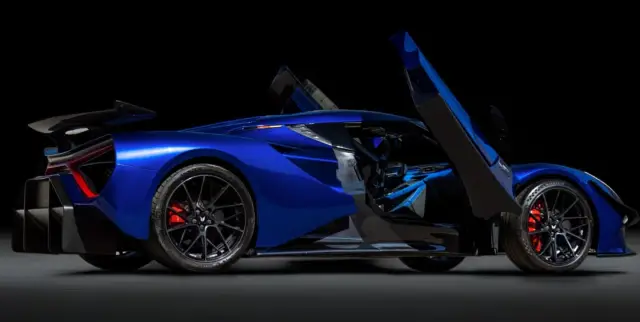
Visually, the Elektron Quasar looks as if it has just escaped from the track for the “24 Hours of Le Mans“, but with a pinch of space aggression. The body, inspired by racing prototypes, relies on blatant active aerodynamics, huge “thirsty“ air intakes and spectacular doors, winged and opening to the sky. Underneath this impressive shell is an ultra-light monocoque made entirely of carbon fiber. Thanks to an uncompromising diet of carbon, the engineers have achieved a real miracle for the electric car segment, tipping the scales at just 1,427 kilograms.
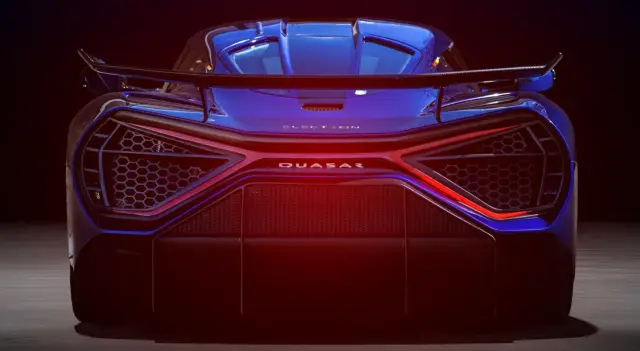
However, the real magic happens where the human eye cannot see. The drive is entrusted to four independent electric motors, which generate a mind-boggling 2,413 horsepower and a monstrous torque of 2,790 Nm. When this brute force hits the asphalt, the Elektron Quasar rockets from a standstill to 100 km/h in a mind-boggling 1.65 seconds – an acceleration that literally takes your breath away and blurs your peripheral vision. To keep this rocket on the road, the aerodynamic package generates a crushing 1000 kg of downforce at a speed of 300 km/h, ensuring rail-like stability.
Engineers claim that the theoretical ceiling of the model's capabilities exceeds the cosmic 525 km/h, but for serial copies the maximum speed will be gentlemanly limited to a “modest“ 450 km/h. To master this element, intelligent adaptive sports suspension and brutal carbon-ceramic brake calipers come to the rescue, capable of biting the discs to a full stop without any thought.
Future owners will not be subjected to the so-called “range anxiety“. The model will be offered with a choice of two traction batteries with a capacity of 80 and 103 kWh, providing a transition on a single charge of up to 480 or a remarkable 602 kilometers, respectively. The modern 800-volt architecture allows “pumping“ battery to 85% in just 15 minutes – just enough for a quick espresso at the gas station.
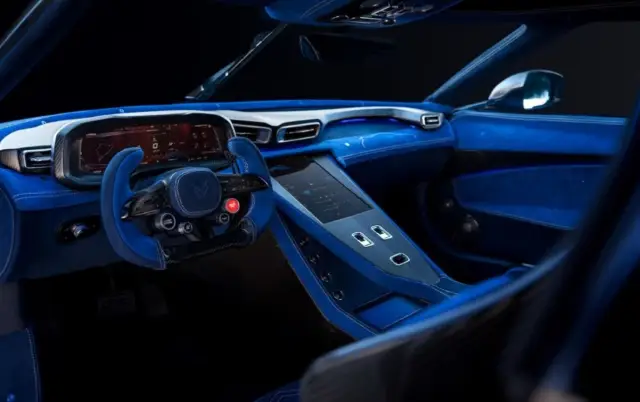
The interior of the cockpit welcomes you with a lavishness of carbon and fine Alcantara. The interior is entirely subordinate to the pilot's feeling, with the traditional steering wheel giving way to a futuristic "helmet" type steering wheel. A clean digital instrument panel shines before the driver's eyes, and the center console is dominated by a large vertical multimedia display, through which this entire orchestra of insane power is conducted.